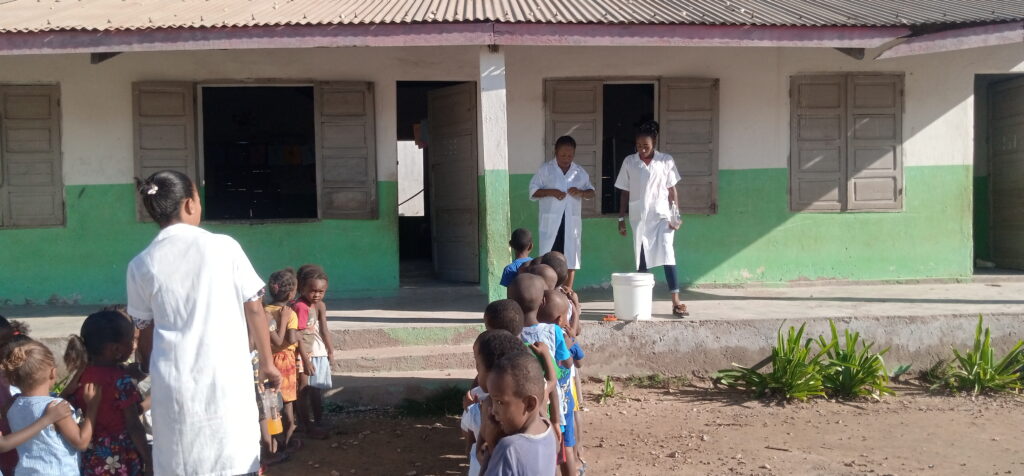





An increase in malnutrition cases, rising unemployment rates, and school dropouts are just some of the lingering consequences of COVID-19 in the daily lives of the people of Tulear. A closer look.
April 2022. We are in Mangily, situated between the desert and the sea, a fairy-tale landscape where ancient baobabs meet the coral blue ocean. Yet, life here is far from idyllic. Since the crisis and the closure of the territories, the local population, which relied solely on tourism, found themselves without resources overnight.
Life must go on, but at the General Education College, the classrooms are only half full. “Before being appointed as principal in October 2021, I had been teaching physics here since 2017. Students used to enjoy coming to school. But I’ve noticed that since the COVID-19 pandemic, especially after the lockdown periods, this has changed. COVID-19 had a significant impact on education. After months of confinement, the students seem to have developed a taste for absenteeism and lost interest in school,” says Renahiny Pierre Chrysologue, principal of CEG Mangily.
Most of the parents of students at CEG Mangily work in nearby hotels or depend on tourism. “But tourists are not as numerous as they were before the pandemic. As a result, it has become increasingly difficult for parents to pay the monthly contribution of 2,000 Ariary per student, which is used to fund FRAM teachers. Many of them have no choice but to stop sending their children to school,” he continues. It is worth noting that 7 out of 18 teachers at CEG Mangily are paid by the students’ parents.
The school principal laments the high rate of school dropouts. And this issue is far from isolated, as it is affecting many educational institutions, both public and private. A source from the Regional Directorate of National Education in Atsimo Andrefana confirms this, stating that job losses are the root cause of the situation. “Many parents are forced to withdraw their children from school and involve them in the workforce so that they can help support the family,” our source reveals.
Young Girls at a Disadvantage
“When it comes to making a choice, families prefer to send boys to school rather than girls,” laments Dely, who runs the preschool class at EPP Mahavatse I. This sad reality has become a common occurrence in the capital of the Atsimo-Andrefana region. Living in the neighborhood of the Ankililibe salt works, she made this heartbreaking observation. “An organization is working here to make quality education accessible to the most disadvantaged children, yet parents prefer to send their children to work at the salt pans for small daily wages,” our source points out, saddened that parents do not see the long-term solutions. The situation is such that certain areas have been identified as “red zones”: the Ankililibe salt pans, the diamond mines of Sakaraha for child labor, and the beaches of Mangily for sex tourism.
For the 2019-2020 school year, 272,780 boys were enrolled in primary school, compared to 147,467 girls. As the grade levels increase, fewer girls are enrolled in school. In addition to parental causes, the students themselves are no longer interested. As the principal of CEG Mangily points out, “Once they reach a certain age, young women prefer to start romantic relationships instead of focusing on their studies.”
Reported Acts of Violence
In addition to the right to education, children’s right to be protected from all forms of abuse is also being violated. According to statistics gathered from the Toliara Child Protection Platform, nearly 590 complaints were received between 2020 and 2022. This figure represents an increase compared to previous statistics. The platform used to receive about six to seven complaints per month.
Cases of sexual violence were the most frequent, accounting for 13.55% of all reported incidents. “It’s not a very positive situation, but it’s a fact. It might be an oversimplification to attribute the rise in cases of violence against children solely to COVID-19, but we can’t dismiss it,” explains Soaniriko Louisetinah, a coordinator with the platform.
Furthermore, several local NGOs have reported an increase in cases of malnutrition. “Certainly, linking COVID-19 directly to malnutrition is difficult to prove. Beyond the health crisis, climate change had already been a major factor contributing to malnutrition, and the period of ‘kere’ (hunger) coincided with the arrival of the pandemic. But we can say that COVID-19 has exacerbated the situation in terms of malnutrition,” reports Claudine Jacquemet, head of the NGO Action Against Hunger in Toliara. This is a fact confirmed by the NGO Bel Avenir and observed at the CSB2 health center in Antsahalava, according to the statistics collected. “We noticed an increase in cases of malnutrition since the first cases of the epidemic. Previously, we hardly registered any cases, but during the height of the COVID-19 crisis, these cases surged, and we were able to record about seven cases per month,” says the head of the CSB2 in Antsahalava.
The head also notes a decline in attendance at health centers, particularly since the onset of COVID-19. She suggests that people are less concerned about medical services due to the high cost of living and now prefer to turn to natural remedies.
Insecurity
The issue of job losses, coupled with the rising prices of essential goods, has created a volatile mix: insecurity. Willy Martial Ranoarison, regional director of public security in the Atsimo Andrefana region, explains: “Insecurity is growing at an alarming rate. It is now manifesting in acts of banditry and crop thefts in the fields. It is no longer just limited to cattle thefts, as it was before.” People no longer dare to go out late at night. “Our lives have changed drastically since the pandemic arrived in Madagascar, even though Toliara did not experience COVID-19 as severely as, according to reports, the capital did. Before, we could go out at any hour without worry. Now, it’s impossible for us to leave after 9 p.m. for fear of bandits,” says a young woman who lives in the Mahavatse neighborhood. She even fears that cycle-pousse drivers may be in collusion with the bandits who target their customers.
The regional director of public security notes that while firearms used to be the exclusive domain of cattle thieves, even street criminals now have access to them. Statistics collected by the National Gendarmerie Group of Atsimo Andrefana reveal an increase in acts of banditry and cattle theft. The statistics from the National Gendarmerie Group of Atsimo Andrefana mention 212 cases of zebu theft in 2021, with 127 arrests, as well as around fifty acts of banditry and an equal number of arrests.
Uncertain Economic Recovery
It is still too early to talk about an economic recovery in Atsimo Andrefana. Known for its droughts, the region struggles to rely on agriculture. Worse still, according to the Director General of Public Security, the dahalo (cattle thieves) are currently targeting farmers. “It is not uncommon to see armed attacks in the fields, with bandits stealing agricultural products.”
Hunger truly justifies the means. Regarding tourism, hotels are trying, as best as they can, to stay open despite the lack of international tourists. Between taxes and employee salaries, most hotels are merely managing to keep operations afloat while waiting for the recovery.