




Villagers living near the mining site of Quit Minerals Madagascar (QMM) in Taolagnaro (Anosy) have raised concerns. Since February 2022, sewage leaks from the operations of this mining company in southeastern Madagascar have been polluting the waterways used by the villagers of Ampasy Nahampoina, Ankaraka, Ankorabe, Bevoay, and surrounding hamlets. The affected communities are demanding clear information and immediate, effective measures for health protection and prevention.
On Wednesday, March 3, we meet Victor in Ampasy Nahampoina, a rural commune in the district of Taolagnaro, in the Anôsy region. Since February, residents who rely on nearby spring water for their daily consumption have been complaining that the water is polluted. Victor explains: “Today, the water is really dirty. It has turned black or yellow. I fetched water from the river and noticed that it is undrinkable.”
Eye and Skin Irritation
The watercourse runs along other villages: Ankaraka, Ankorabe, Manambaro, and Mandromodromotra. If the water is polluted, the residents of these villages are also at risk, as there are almost no other sources of drinking water in the area: “We get skin irritation when we come into contact with the water. Others have eye pain. We suspect that these leaking waters carry disease,” explains Victor.
A representative from the Ampasy Nahampoana commune highlights the concerns of the population: “This is at least the second time we’ve been victims of sewage leaks. QMM’s operation is located at a higher elevation, and the watercourse running through our village is downstream. We fear that, through infiltration, the radioactivity of these polluted waters from mining activities could contaminate our drinking water sources. There should be a legal distance between the mining site and sensitive areas like watersheds, based on the infiltration rate. Yet, QMM’s site is precisely located in a sensitive area, in a watershed!”
The residents of Taolagnaro share these concerns. Narcisse Razafimahatody from the Anôsy Miray association does not hide his worry: “The entire Taolagnaro district is affected because the city is supplied by the Lanirano River, where other potentially polluted watercourses discharge. This is the water we consume every day!”
Ampasy Nahampoana, the first village to be affected, is located about 3 km from the basin where QMM is situated. An anonymous source explains: “Around 500 meters from the dredge, we can already see sand deposits. However, this is no longer natural sand. It has already gone through various industrial treatments and is likely loaded with heavy metals. When there is a spill, both the sewage and the treated sand leak at the same time. It’s close to Ampasy because, by sight, the closed-loop canal is established about forty meters from the water sources…”
Complaints and Investigations
On February 10, 2022, the National Office for the Environment (ONE) announced that the Ampasy Nahampoana community had filed a complaint regarding contaminated water. According to local sources, a team from QMM conducted an initial field inspection and “saw nothing abnormal.” In a statement issued on March 9, 2022, QMM asserted that “the initial findings regarding the integrity of the berms led to the conclusion that the phenomenon observed following the first complaint was not caused by QMM’s activities.”
A second complaint from the villagers of Ampasy Nahampoana regarding river contamination was filed again on February 18. The following day, the community, along with the deputy mayor, organized another field inspection and observed “water leaks emanating from the piezometer,” as one local source confides. A piezometer is a device used to measure liquids at a specific point.
On February 22, a joint team consisting of the local ONE team, representatives from civil society organizations (CSOs), members of the regional environmental monitoring committee (CSER) of Anôsy, the deputy mayor of Ampasy Nahampoana, and QMM agents conducted another inspection to observe these leaks. The minutes of this inspection, a copy of which we have obtained, states that “an investigation has been conducted since Saturday” (February 19, 2022, editor’s note); following the community’s initial complaint, “an investigation was also carried out,” at the end of which “it can be confirmed that the embankment is in good condition.” However, this joint inspection did reveal that “leakage points were identified near the buffer zone; no water is visible seeping out because a small sand dune has blocked the breach; a black deposit was found on the surrounding vegetation, which was crossed by these dirty waters.” QMM promised to “reinforce the embankment” and “meticulously identify the contaminated areas and waters,” according to the same minutes.
On March 6 and 7, another inspection took place. A source who participated in this inspection confided: “We observed the existence of a small embankment along a canal, and a closed-loop system managing the wastewater from the mining operation. The wastewater flows along the dredger and circulates in the closed-loop system. However, the water level has noticeably risen in this closed-loop system. The embankment was flooded, and the wastewater spilled into the nearby sources in Ampasy. The contaminated watercourse runs through the villages of Mandromondromotra, Ankorabe, and beyond. This wastewater comes from the floating factory.”
Samples Under Analysis
In its statement of March 9, QMM stated that it had “called upon the services of Intersafe, an independent expert in incident analysis, to support the local investigation team” in order to “ensure the objectivity of this investigation.” Water samples were collected from eight points in the presence of regulators, namely the ONE and the National Water and Sanitation Authority (ANDEA). These samples are set to be analyzed by both QMM’s laboratory and the laboratory chosen by the regulators. “If a cause-and-effect relationship is identified between the recent water disturbances and the mining operations, QMM commits to presenting a remediation plan.”
Meanwhile, QMM explained that it is conducting a “temporary release of water from the settling ponds at its ilmenite mine in Fort-Dauphin” following heavy rains that caused the ponds to reach capacity. This action is said to be “completely controlled,” and QMM assures it will implement remediation measures if any effects are observed on the sites.
Public Interest Questions
This “exceptional” water release is said to have been authorized by ANDEA and concerns a volume of one million cubic meters of water for the next seven weeks. It is possible that this represents the entire content of the settling ponds, and as such, the water may contain high levels of radionuclides and other contaminants, including the exceedances that QMM has already admitted (regarding cadmium and aluminum). This situation raises many questions, including:
The Scientific Aspect Not to Be Overlooked
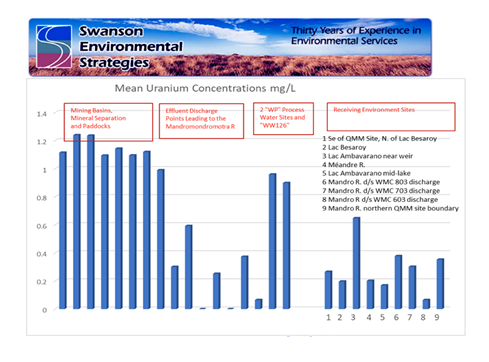
Dr. Swanson, in her memo (2019a), is firm. “Even though uranium is naturally present in the ore, once the ore is extracted and processed, uranium is released into the water in greater quantities than if it were left in place in the soil” (Swanson Memo, 2019a). When Dr. Swanson revisited the water data from QMM, she found that samples indicated higher concentrations of uranium in the mining basin, ranging from 0.899 to 1.237 mg/L; and at one location, between 1.513 and 2.029 mg/L (ibid).
Swanson notes that radionuclides in water, in this case uranium, can enter surface waters via the discharge of QMM’s effluents into the Mandromondromotra River, and from there, flow into Lake Ambavarano, Lake Besaroy, and potentially even further into Lake Lanirano, which supplies drinking water to the urban center of Fort Dauphin. Runoff after heavy rainfall can also carry soil particles containing radionuclides from the QMM site into adjacent wetlands. “The QMM mine definitely releases more uranium into the water at the site, thus creating an enhanced source of uranium into the Mandromondromotra River and Lake Ambavarano” (Swanson Memo, 2019a) (2).
QMM does not share this view, but it would be interesting to know the conclusions of Malagasy scientific entities on the matter in order to have a clearer understanding of the issue.
Where to Draw Drinking Water?
Returning to the aftermath of the incident, the Minister of Health and the Minister of Water, Sanitation, and Hygiene visited Taolagnaro and the villages affected by the water leaks. The villagers are expecting the authorities to implement drastic and effective measures to prevent such incidents in the future. The Minister of Water, Sanitation, and Hygiene promised that “any potential impacts of this incident will be attributed to the company,” according to his statements reported by Midi Madagasikara on March 10, 2022. The sanction could take the form of an administrative seal prohibiting QMM from discharging wastewater, and the implementation of a water treatment system before release, according to the Minister’s remarks.
While awaiting the results of the investigations and analyses mentioned earlier, the surrounding populations appear to be stuck, as these contaminated rivers are their only means of drawing water on a daily basis. “These leaks don’t just happen like that! They are there because standards have not been respected by the technicians. But the population cannot deprive itself of water,” argues a villager, one of the victims of the polluted waters of Anosy.
For now, the company has reportedly agreed to organize water supply for the communities near its mining site. Civil society, however, is calling for a decision with long-term impact: “We had asked for Taolagnaro to be supplied by the Efaho River, not by Lanirano, which is already potentially contaminated,” says Narcisse Razafimahatody.
The results of these investigations and analyses are expected to be delivered by the end of March 2022. The public health concerns related to these mining operations are more than worrying, given that such activities always pose a significant risk to the communities. The Publiez Ce Que Vous Payez (PCQVP) Coalition of Madagascar had previously produced a collection of citizen perceptions regarding water pollution in Mandena. It is currently finalizing a second report that deepens the harmful effects of mining activities on surrounding communities, in their social, economic, land, and health aspects. The full report will be officially released to the public in April 2022, but a presentation of the preliminary results and recommendations was made on March 11 in Taolagnaro. On the same day, a new field inspection was organized in the areas affected by the water leaks from the basins, with the presence of local civil societies.
This incident is far from over, and vigilance and accountability from all stakeholders are essential to prevent further difficulties for the local communities.
The MALINA Network in collaboration with PQCVP MG
Follow and share the testimonies of the villagers on the Facebook page of Transparency International-Initiative Madagascar.
(1) Memo to ALT UK from Swanson Environmental Strategies, August 2019 https://bit.ly/3t3dwaL
(2) Beyond this memo, read all available information here – Water Briefing on QMM, ALT-UK, 2020. https://bit.ly/3CBf1jA