




[Article updated on 11/01/2023]
The famous Mer d’Émeraude bay, located in the Andranovondronina commune in the DIANA region in the north of Madagascar, is currently suffering from anarchic and illegal seaweed farming. Surrounded by small islands such as the Suarez and Diégo islets, this marine area popular with tourists is undergoing serious environmental degradation, with pollution, suspicions of corruption and health concerns.
The root of the problem : a company owned by Chinese nationals whose identity remains unclear. According to the authorities, their operating methods are considered to be less than rigorous and potentially dangerous. Rabialahy Jean-Paul, Regional Director of the Maritime and River Port Agency (APMF) in Antsiranana, points out that ‘the lack of clear measures imposed by the Malagasy government on operators in this sector is at the root of the current situation’.
It was the Ministry of Fisheries that issued the authorisations for cultivation or marine exploitation. However, according to APMF, there has been no consultation, either on the transport of people or on the use of equipment likely to pollute the ocean, such as the plastic bottles used by the company to cultivate algae.
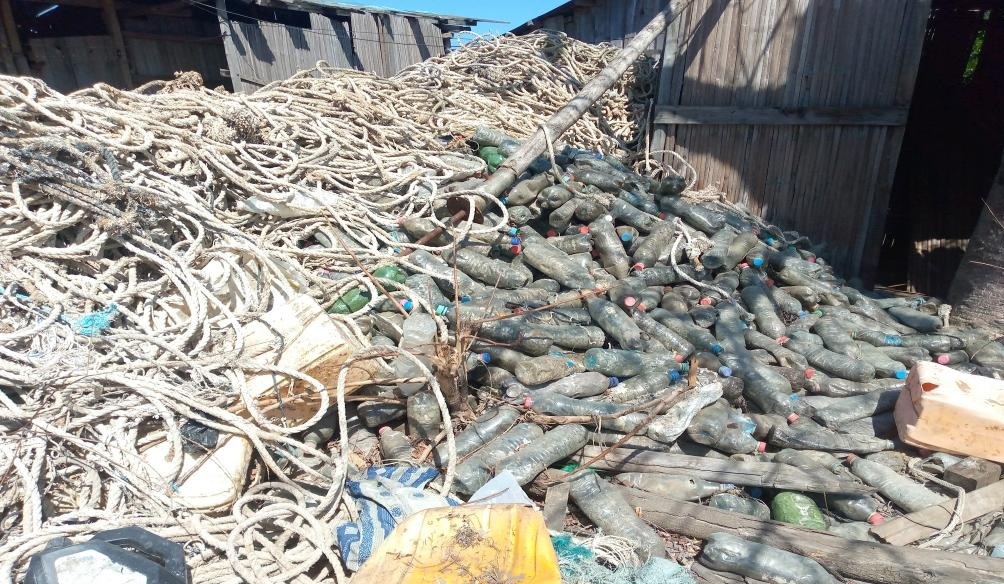
These bottles are used to fix the young algae shoots, but they represent a direct threat to marine fauna, particularly large fish, not to mention the overall environmental impact and the risks to the tourism sector. ‘This practice goes against the principles of the APMF, which works to preserve marine environments,’ deplores the regional director. Local marine biodiversity is under serious threat.
Non-compliant boats to blame
The journey between Ramena and the Emerald Sea takes around 45 minutes by speedboat. But it is at Ankorikahely, a more remote site, that the Chinese company has set up its seaweed cultivation camp, where it prepares the equipment and seeds for transfer to the Emerald Sea.
For these operations, the company uses zahatra, traditional non-motorised boats that have no legal approval. These means of maritime transport do not meet any safety standards : they do not have a navigation licence, nor do they have the statutory life-saving equipment such as life jackets. Under current regulations, in particular decree no. 2918 of 1 September 1972 on safety at sea, the use of such craft is formally prohibited for transporting people or equipment.
However, local councils seem to be turning a blind eye, as this activity provides direct employment for some of the local population.
An area reserved for tourism or for seaweed farming ?
According to Befourouak Francis, Chairman of the Board of Directors of the DIANA Regional Tourist Office, the illegal exploitation and transport of seaweed poses a real problem for the tourism sector.
“The tourist itineraries we offer have to be modified, because the sea routes are littered with plastic bottles used for seaweed farming. We’re still having problems because the company hasn’t removed the wooden stakes and iron bars that it planted in the sea around the Emerald Sea. This area is very popular with visitors. It would therefore have been preferable for the ministry concerned to take the time to consult the local authorities before issuing the operating permit”, he concluded.
The DIANA region does, however, have its Regional Development Plan (PRD) and its Regional Spatial Planning Scheme (SRAT), which are supposed to serve as a roadmap for both investors and public officials. But as Raharimalala Sylvie, DIANA’s Regional Director for Fisheries and the Blue Economy, explains, the lack of maritime spatial planning means that these documents are partially ineffective. ‘Despite the existence of the PRD, actions overlap, because there is no clear organisation of the use of maritime space’, she explains. Yet the PRD itself recognises that this area is particularly favourable to the development of coastal and maritime tourism. Hence the question posed by the chairman of the board of directors of the DIANA regional tourist office : “Do we want to promote tourism or focus on marine culture in the Emerald Sea zone ?
A company that failed to honour its commitments
According to Raharimalala Sylvie, Regional Director of Fisheries and the Blue Economy, another area had initially been allocated to Chinese nationals for seaweed farming. They were authorised to set up in the fokontany of Andohazompona and Antsikala, located in the rural commune of Andranovondronina. However, they settled in the fokontany of Cap Diégo, in the district of Antsiranana I, as well as in Ankorikahely and on the shores of the Emerald Sea.
Although an agreement has been reached, the identity of the Chinese nationals and their company remains unclear: no one in charge has been clearly identified. The only name known is ‘Lee’, according to the inhabitants of Andovokônko, in the Morafeno fokontany in the Andranovondronina commune. Both the mayor of Ramena and the mayor of Andranovondronina claim to have seen a letter ‘supposedly issued by the Ministry’, but neither of them has an official copy or any records to prove the formal arrival of these operators.
The only written trace found in the commune of Andranovondronina is a document referring to specifications, without the name of the signatory or mention of the company concerned. To date, the identity of the company involved in seaweed cultivation remains unknown. The mayor of Antsiranana formally declared: ‘I was not at all aware of their presence in the Cap Diégo fokontany’. When questioned, the head of the fokontany concerned confirmed: “The Chinese arrived without warning. They didn’t consult either the residents or the local authorities. Their activities disrupted the fishermen in the area.
This situation has caused tension within the community. Some residents have benefited from the exploitation by renting marine areas to Chinese operators for 5,000,000 ariary a year. But others, particularly fishermen, have seen their activity interrupted, as access to their fishing zone has been forbidden due to the presence of seaweed crops.
Faced with this injustice, the inhabitants of the Cap Diégo fokontany, led by their chief Mahasolo, decided to evict the seaweed growers. They moved to the ‘firing range’ used by the military, but were immediately chased away by the army. They then retreated to Ankorikahely, in the commune of Ramena. The majority of villagers were opposed to them moving in, but mediation led by the head of the Ankorikahely fokontany enabled them to do so. The mayor of Ramena, for his part, approved their request, with the result that the communes of Antsiranana I (town), Andranovondronina (rural) and Ramena (rural) are now all home to seaweed farming activities.
Violation of laws and transgression of traditions
A mother living in Andovokônko, who wished to remain anonymous, denounced having been used as a ‘persuasion tool to get the population to accept the arrival of the Chinese operators’. Sent to convince the villagers of the alleged benefits of seaweed farming, she recounts : “I was given false promises, journalists were brought in and everything was covered by the media. But nothing that was promised to me has been delivered. I feel both betrayed and guilty for misleading my loved ones.
Disrespect for local traditions is also a source of tension. Rachid, a resident of the area, is outraged by the marine pollution : “Local customs were totally ignored as soon as the operators arrived. Back home, we don’t throw anything into the sea, especially not where our ancestors live. It’s a sacred place : we get our food there and we pay homage to the spirits. Yet they have polluted the water without any regard. We’ve alerted the sector chief, but nothing has changed. Our traditions have no value in their eyes, and now the coastal waters are full of excrement. We are oppressed by the presence of these seaweed farmers.
Non-compliance with specifications is also a major problem. Workers work nine hours a day, but wages are unfair: 8,000 ariary a day for men, compared with 6,000 ariary for women. The company had promised to build a primary school, a health centre and to provide electricity and water on the site. Four years on, none of these promises have been kept.
An unknown business, off the tax radar
Seaweed growers in Andranovondronina have never paid tax to the local authority. They have been in business for more than four years and claim that they have not generated sufficient production. “They keep referring to financial losses to justify their failure to pay tax. No profits have accrued to the municipality; only a few individuals have benefited from their presence. I was never informed that the people in charge were coming, probably to prevent me from seeing the bribes being handed out”, says Jaofeno Berobia, mayor of Andranovondronina.
In the commune of Ramena, where the production storage and transit facilities are located, irregularities in financial declarations have been noted. “It’s impossible to know when they take the goods out of their warehouse. On one occasion, I caught them loading four lorries, each carrying 25 tonnes of produce, when the documents only stated 3 tonnes”, reports the mayor of Ramena, Bemamory Tavandra.
He adds that it is difficult to ensure reliable control due to the lack of appropriate weighing instruments.
They left without cleaning up !
In June 2022, Chinese nationals demolished all the facilities they were occupying in Andovokônko and Ankorikahely. According to the mayor of Andranovondronina, their departure took place in a climate of obvious anger. As well as the equipment they took with them, they left debris of wood and other materials on the shoreline, which had been used to hold up the shelters they had built. As a result, the shoreline is completely polluted. Worse still, the wooden stakes and metal bars planted in the sea to support the ropes used to grow seaweed have not been removed. As a result, navigation has become impossible in the areas close to the village : pirogues and small boats now have to wait for high tide to get around.
The Chinese nationals refused to speak and said they spoke neither Malagasy, French nor English, making it extremely difficult to communicate with them. It was local employees who informed us of their intention to relocate to Nosy Faly, in the Ambanja district.
Update (11/01/2023) : According to a publication on the official page of the Ministry of Fisheries and the Blue Economy, dated 8 January 2023, ‘the clean-up of waste and restoration of the site have been undertaken with respect for the environment and the standards in force’, at Ankorikahely, rural commune of Ramena, district of Antsiranana II, DIANA region. The site is said to have been ‘used exclusively for growing algae, and is now overrun with rubbish and plastic bottles’. The ministry also states that ‘measures have been taken against the company concerned’, without specifying the nature of these measures.
Still according to the Ministry, on 11 January 2023, the DIANA Regional Directorate for Fishing and the Blue Economy (DRPEB) carried out a raid on the site, stating that it had implemented ‘concrete actions such as inspections, letters of suspension and seizure of equipment’. The directorate points out that this was only an agreement in principle to grow algae, and not a formal authorisation to set up an experimental site or build infrastructure. Such a permit would require an environmental impact assessment of the project, which is a prerequisite for any legal occupation of the site.