




Despite the promises of development linked to graphite exploitation, municipalities like Fotadrevo and Ambinaninony struggle to see concrete benefits. Amid delays in payment of mining royalties, dilapidated roads, and limited access to basic services, the wealth extracted from the ground does not seem to benefit the local populations, who face persistent poverty and precarious living conditions.
Vague rebates
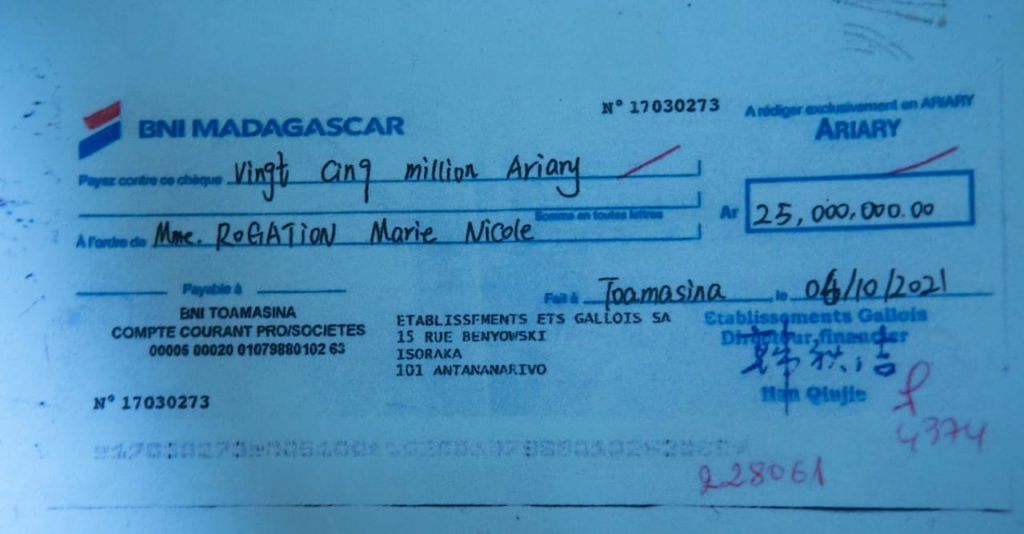
In Ambinaninony, the national road 2 illustrates this paradox well. Trucks carrying graphite, stamped with the logos of the Gallois Establishment and Tirupati, raise dust and disillusionment every day. Although the Tirupati company has been extracting 9,000 tons of graphite annually since 2015, the benefits for the local community remain vague. A public school, funded by a check of MGA 25 million sent directly to Mayor Marie Nicole Rogation, has never come to fruition, raising suspicions about the management of the funds.
It is in this municipality of Ambinaninony, in the district of Brickaville, on national road 2 that the company Tirupati began operations in 2015. The company produces 9,000 tons of graphite per year. A profit that is not reflected in the municipality’s infrastructure despite the support from the company Tirupati. Indeed, it has provided its support for the implementation of a new public primary school up to standard and for the equipment of the police station as part of their social action projects.
In this municipality, there is silence regarding these famous mining royalties, while the company states that they have indeed been paid. The project managers at the establishment admit to a payment delay: “Taxes worth MGA 1.8 million have not been paid yet by the Central State for two years.” Unpaid taxes which, according to the managers, are becoming a hindrance to the proper functioning of the company.
A ghost school
But Tirupati, like the Welsh Establishment, continues to engage in social actions. A check for MGA 25 million in the name and personal account of the former mayor of the municipality of Ambinaninony, Marie Nicole Rogation, was signed by the financial director of the company on October 6, 2021. This amount was provided by the Welsh Establishment to pay for the construction of a Public Primary School in the Ambodizarina neighborhood. According to the company’s officials, this assistance is a “responsibility, knowing that most of the residents of the surrounding municipalities work there.” A paper signed by the mayor herself certifies the receipt of the sum by the municipality of Ambinaninony. However, up until now, the work to upgrade the school has not begun yet.
Article 242 of the Mining Code states that agreements on Corporate Social Responsibility are made between the authorities of Decentralized Territorial Communities, followed by a report in the environmental specifications document. The latter document was not presented to the team during their visit to the municipality. On the other hand, according to article 283, any financial contribution from Rights and Administrative Taxes must be paid to the Decentralized Territorial Collectivity, and not to an individual. The mayor of the city has been the subject of investigations by the Independent Anti-Corruption Bureau (Bureau Indépendant anti-Corruption – BIANCO) shortly before the launch of the municipal elections in December 2024. This did not prevent her from running for her succession, but she lost the elections against an independent candidate, according to the results published on the website of the National Independent Electoral Commission (Commission Electorale Nationale Indépendante – CENI).
Delays
On the side of the fokontany of Antsirakambo, in the municipality of Ampasimadinika Manambolo, district of Toamasina II, the atmosphere is different. In this part of the municipality where the Welsh Establishment is located, access is restricted, subject to having a written authorization from the company. But for Iambina Jean-Paul, the mayor of the municipality and a former employee of the company, the Welsh Establishment has always been attentive to the needs of the community.
The official confirms having received the benefits for his municipality. The Welsh establishment was set up in the 1990s. Its production is greater than that of Tirupati, as it is currently between 500 and 1000 tons per month, over an area of 125 square kilometers in the fokontany of Antsirakambo. A production that reports MGA 128,992,234 in profits for the municipality of Ampasimadinika in 2024. The amount has not yet been deposited into the municipality’s account at the time of the interview, as well as part of the refunds from the year 2023 amounting to MGA 33,301,301.
« Even if the value of the production of the Welsh establishment is not yet clear to us, we have been told that this amount is the share of Ampasimadinika. Other municipalities like Vatomandry are questioning the true value of the discounts. For our part, we are not following this closely, even if there are some concerns,” Iambina Jean-Paul admits.
The website of the Mining Cadastre Office (BCMM) displays a properly documented payment of a rebate that is substantially equal to that mentioned previously, in 2023. Especially since for a mining company, the payment of administrative fees and other charges is a necessary condition to continue operations according to article 354 of the Mining Code. In response to this, Iambina Jean-Paul remains alert, but the money is struggling to be released from the Public Treasury. Rakotovao Andriamihaja, district chief of Brickaville – after a meeting with the mining companies – explains the delay: “The officials at the companies indicated that they have gone through difficult times after the Covid-19 period.” They were therefore unable to pay a portion of the rebates for a short time.” The Welsh establishment and the company Tirupati were able to continue to operate during this period by paying part of the charges that were required of them by the BCMM.
More than royalties
In the municipality of Ampasimadinika, as in that of Ambinaninony, the frustration of the residents is not limited to payment delays. The accusations of environmental pollution from mining are intensifying. In Ampasimadinika, allegations of water pollution caused by mining are fueling a growing sense of distrust, while in Ambinaninony, rice fields are being buried in sand.
The Regional Directorate of Environment and Sustainable Development (DREDD) Atsinanana acknowledges that these issues often reveal the non-compliance of companies with specifications. According to Tezena Armando, the regional director of DREDD Atsinanana, this situation would be motivated by the pursuit of superprofit. In addition to the delay of the refunds, there are other compensations that the two companies must address.
For the Welsh Establishment, compensations are carried out according to the rules in Antsirakambo. “In 2022, we financed the rental of equipment for earthworks, amounting to MGA 19 million for the preparation of a site. There is also the rehabilitation of the General Education College for a value of MGA 3 million, or the provision of more than MGA 3,600,000 in fuel for the Toamasina prefecture. Every year, the company undertakes a social project tailored to the community’s needs. We also established the Antsirakambo cultural center and funded repair works on the pavement amounting to up to MGA 12 million.” The donations from the company are numerous, some even contribute to the support of public teachers in the fokontany. It claims to have paid, in addition to this aid, more than MGA 200 million in fees for each municipality.
The managers of the Welsh Establishment explain that these social actions are a way to maintain a good neighborly relationship with the community: “We do not really see the benefits in the fokontany of Antsirakambo, where the operation takes place, and that is why the company is striving to multiply social actions.”
Iambina Jean-Paul, mayor of Ampasimadinika, the site of the exploitation, cannot help but express concerns: “We ask them to take action when the municipality cannot provide for itself. But we try not to ask for too much, for fear that they will take advantage of it. We only make requests when it is really necessary.” The municipalities of Ampasimadinika and Ambinaninony remain silent.
The Molo Project: A Giant of Graphite
In the Southwest of Madagascar, the town of Fotadrevo, nestled in the heart of the Ampanihy district, offers an arid setting. Entering the market square, the air is thick with dust, the heat is oppressive, and the ambient noise of the vendors creates a lively cacophony. Under modest stalls, the locals sell vegetables, fruits, poultry, and local products like ‘habobo’, a fermented milk typical of the region. Crouching on the ground, a cassava seller named Soafilira, visibly exhausted, bitterly shares her daily life: “I suffer greatly. We can hardly sell anything. The cost of living is high, yet there is a very powerful company here, but it does not help us.”
This company is NextSource Materials, a Canadian firm that has been mining graphite in this remote area for several years.
NextSource Materials, whose headquarters is located in Antananarivo, is also known as ERG and undertakes large-scale operations in Fotadrevo through its flagship project: Molo. This graphite deposit is recognized as one of the richest in the world for high-quality Superflake flakes with 98% pure carbon. According to the Extractive Industries Transparency Initiative (EITI), Madagascar has an estimated reserve of 26 million tons, placing the country among the six leading global producers, alongside India and China, and in second place in Africa after Mozambique.
The Regional Director of Mines, Raonison Ria, confirms that the new Mining Code, although promulgated, remains inoperative due to the lack of an implementing decree. For now, the regional directorates are limited to managing permits and issuing transfer orders related to mining royalties.
The Mining Royalty Question
According to order 2020-1000, mining royalties must be distributed as follows:
• 16% to the provinces,
• 14% to the municipalities,
• 30% to the BCMM,
• 1% to the EITI,
• 2% to the National Mining Committee,
• 2% to the ANOR,
• 35% to the State’s general budget.
However, the mayor of Fotadrevo, Randriamanga Théodore, laments the absence of payments to the municipality, despite the intense activity of ERG (the local subsidiary of NextSource Materials). “ERG started exporting in mid-July, but no funds have yet been paid to the municipality,” he explains.
Despite the optimism displayed by the company, large-scale exploitation is still hindered by several factors. Wilhem Reitz, General Director of ERG, highlights logistical and regulatory challenges: “We have paid mining administration fees since 2015 and we obtained our operating permit in 2019.” However, export is slowed down by customer requirements, who want larger quantities before any shipment to Mauritius, where we have a processing plant.”
ERG is currently shipping between four and five trucks per week to its warehouse in Tuléar, with each truck carrying about 10 to 15 tons. Production currently reaches 4 tons per day, well below the initial targets of 40 tons.
A modern enclave in the middle of the desert
The establishment of ERG in Fotadrevo contrasts with the surrounding poverty. The site, designed as an autonomous village, includes modern infrastructures: spacious housing, a colorful cafeteria, a well-equipped gym, a basketball court, and even a swimming pool under construction. Powered by solar panels, the site produces more energy than it consumes, setting an exemplary model for sustainable energy.
Eulalie Tanteliniony, representative of ERG, highlights the benefits for the local community: “We employ 250 people, including locals, and have initiated reforestation projects and access to drinking water.”
Despite ERG’s promises and stated ambitions, the economic benefits for the people of Fotadrevo remain limited. The residents are waiting for tangible benefits, particularly through the mining royalties, which could transform local living conditions. The question remains unresolved: will the mining wealth of Fotadrevo ever benefit its inhabitants? For now, the dust, the heat, and the uncertainty continue to weigh on this small town in southwestern Madagascar.
By Rova Andriatsileferintsoa and Cynthia Rahelindisa