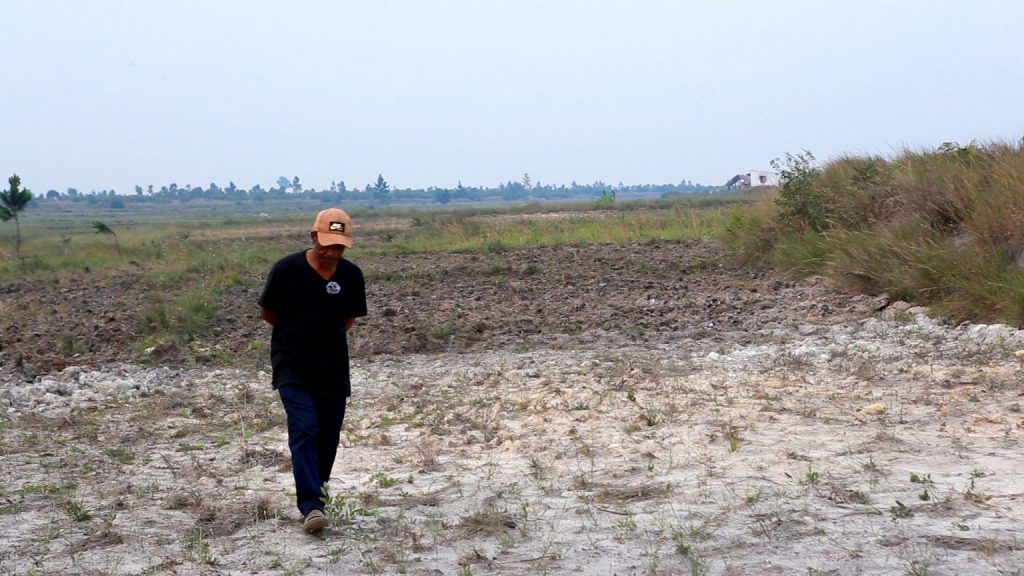





Madagascar, one of Africa’s leading producers of transition metals—nickel and cobalt—is rising to prominence thanks to Ambatovy, a major exporter of these products. As time is running out, the energy transition is becoming a matter of urgency at the international level, but the initiative masks an uncertain economic and social reality for its host country. By 2024, the communities surrounding the company are buckling under the weight of the mining giant. Here is an investigation conducted by Malina journalists in November 2023, at the heart of the communities living in the shadow of the mining giant.
There is only a pond left: Richard Ranalarison stands facing what used to be his land. Everything has been buried. The father of a family has not only lost his rice fields, but also his main source of livelihood, and today he has only his memories, those of fertile lands that he must now replace with hard and sandy soil. “Of course it saddens me, I plowed this land all my childhood, until I got married,” the 40-year-old says. For all this, the Ambatovy mining company offered him land in exchange. That was in 2008, yet the problem still has not been resolved. Ricard Ranalarison’s case is not unique. Wherever the company had settled, turmoil had ensued.
Broken promises, lost lands
2006, life in the peaceful village of Andranovery was disrupted by the sudden arrival of the Ambatovy company. Twenty-nine families were asked to leave their ancestral lands: a mining project was being set up in this locality in the fokontany of Ampitambe, in the commune of Ambohibary, Moramanga. Two years passed, and an agreement was reached: 2008, the families gave their consent “to the national interest and for the development of the country,” as Richard Ranalarison recalls. The project moved forward. The peasants are waiting for their new land, the land they were promised when they left: “In 2008, we, the 29 Persons Affected by the Project (PAPs) and Ambatovy, reached a clear agreement stipulating that they would replace our land with arable and productive land, similar to that of Andranovery,” Richard Ranalarison testifies. While waiting to find replacement land, Ambatovy compensates farmers by providing them with four tons of rice for each hectare left behind, every year. 2011, utopia gave way to disappointment when Ambatovy proposed Ambolomaro as an alternative to the Andranovery land. The soil there is infertile, consisting of peat and fine sand, Richard Ranalarison shares his experience from 2014: “I tried growing rice there, but the yield was disappointing. I only managed to get a meager harvest of 100 kg from more than 2 hectares of land.” In a similar-sized plot in Andranovery, I harvested 8 tons. The father of a family lives in hope of finding a better land, which after all these years has turned into a rage that he expressed in a complaint addressed to Ambatovy in November 2023.
Harsh lands
“The Ambatovy company forced these families to farm in Ambolomaro under threat of losing all compensation.” Andriamananjara Rasolontsilavo, Fokontany chief of Ampitambe since 2009, shares his concerns. In 2016, Ambatovy permanently ceased compensation payments, arguing that the land in Ambolomaro is arable. The sandy and arid soil makes it difficult to grow rice seedlings. The facts are blurred by a reference plot: the company demonstrated the fertility of the land in Ambolomaro by working on 5 to 10 hectares. For its part, Ambatovy insists that the land in Ambolomaro is fertile. Vony Ramahaleo, the company’s press relations officer argues: “While the yield on this land was estimated at two tons per hectare, studies conducted by officials at the Ministry of Agriculture have shown that the yield now reaches around 3.8 tons per season. “ The reality in Ambolomaro seems different: ”We have tried planting here, but production is not as high as in Andranovery. The price is not worth the cost.” Citrus trees, planted by a few families trying to cultivate the land, timidly populate the area. Ambatovy recognizes the value of these groups, which have become associations and which, in its view, help to plow the land to preserve its fertility. Faced with the infertility of the soil in Ambolomaro and the cessation of rice compensation, the 29 PAPs attempted to return to the Andranovery area. This action resulted in legal threats and intervention by the authorities. For Ambatovy, these peasants did not face any form of coercion: “The choice of this land was made after several discussions and an agreement, meaning that from the outset, they accepted Ambolomaro.” Fifteen years later, the inhabitants continue to struggle, in the lingering shadow of lost lands and broken promises.
Danger in Ambohimarina
While this was happening, somewhere in Toamasina, Victoire Angèle Fenosoa, head of block four in the Tanambao Ambohimarina sub-sector, fokontany Tanandava, experienced a similar story. Nestled two kilometers from the main road, among trees and greenery, her village is home to more than 200 households. Fourteen families migrated to this area, leaving their land to the company. In return, they received financial assistance for five years—from 2008 to 2013—while waiting for replacement land. In 2008, the exchange amounted to a sum that Victoire Angèle Fenosoa does not disclose, but which, according to the head of block four, could have covered only two or three months. Today, the villagers remain silent. “We sent requests to Ambatovy, through our mayor, to improve the infrastructure and our living conditions, filling a 200-page notebook. No response has been received,” Victoire Angèle Fenosoa reports. Having grown attached the area, the 14 families decided to stay in Ambohimarina, rather than move to Vohitrambato, the land offered by Ambatovy. Vony Ramahaleo, the company’s press relations officer, explains the process: “The relocation of communities living near the tailings pond was carried out in accordance with the standards imposed by the International Finance Corporation (IFC) on voluntary relocation: there is a technical assessment carried out by experts, followed by an agreement with these communities.”
The official emphasizes that without an agreement, the relocation cannot take place. In the small community of Tanandava, villagers remain hopeful and continue to make requests. Victoire Angèle Fenosoa protests: “Among our requests, we specified that the village needed a doctor, but so far, no one has come.“ The small village situated near the factory’s waste park, it is becoming dangerous for them due to its proximity : ”We used to take water from the river for consumption, but now the water can only be used for laundry, and even bathing can cause itching.” According to the villagers of Ambohimarina, a pipe belonging to the company leaked its contents, and since then, the clarity of the water has been threatened. In 2018, the final report of the European Investment Bank (EIB), the main funder of the project, reported that the park had slightly strident impacts, apart from the high presence of manganese in the running water, a worrying level since July 2015, which can expose locals to respiratory or congenital diseases. In Ambohimarina, fear sets in all too often: “Even the water from the mist cannot be used because it comes from the park’s cycle. Ambatovy representatives advised us to use rainwater only for laundry or washing up, but also to notify them if we smell anything strange, which happens often.” The village of Tanambao Ambohimarina lives with a shared water source: a tap supplied by Ambatovy. Faced with all these requests, Ambatovy has responded: “As a solution for these communities, the company has tried to talk with them: they have proposed land where they would like to move, and we are currently negotiating with the owners of the place where they would like to settle.”
In other areas, dangers are spreading. Three years ago, the small town of Ambodiakatra in Analalava was hit by a scabies epidemic. Ambatovy’s involvement is not underestimated: “More than 300 people were infected in a school in Befotsy, the neighboring fokontany. After carefully studying the facts, we discovered that the sick people were using and bathing in water from a river near Ambatovy”, according to Mahefasoa Herimihaja Rakotoson, head doctor at the Ambodiakatra basic health center (CSB). The locals have decided to use wells for their water consumption and for cleaning. The villagers do not seem to complain about the brown color of the water they draw, as long as each group of households has a well during the dry season. The reality is that these initiatives do not seem to be known to everyone. Accepting and living with it, the villagers’ last words resonate loudly in the small community, and their voices do not leave it.
Futile solutions ?
Justin Andriamanankolafy, president of the special delegation (PDS) of Ambohibary, says he does not feel the benefits of Ambatovy’s activities. Benefits that the municipality of Ambohibary would not have received since 2018, following an old corruption case. In 2013, a new market opened in the village of Ampitambe: the Ambohibary market. Justin Andriamanankolafy expresses his disappointment: “It is a neglected market, now unused. Although Ambatovy contributed to the construction of a market in Ampitambe, it is currently abandoned, mainly due to the gap between the aid provided and the real needs of the population.”
In terms of real needs, the population mainly mentions the need for electrification. This is the case in Analalava, a farming community located less than two kilometers from the town of Moramanga, comprising four villages and 14 sub-sectors.
Pierre Ramaronindrina welcomes us in a room in his house in the Ambodiakatra sub-sector, which serves as his fokontany office. It is here that the fokontany chief opens up: Ambodiakatra is not electrified. Even under the wing of Ambatovy, the sub-sector is lit only by a few candles, oil lamps, and solar panels. While it costs up to MGA 400,000 for a solar panel and two lamps, the initiative is not within the reach of all villagers, and only about 20% of households have access to it. The State is unable to provide electricity to its people: the JIRAMA pole erected a few meters from the village entrance stands uselessly. Pierre Ramaronindrina is indignant about the nearby installation, which cannot produce light on this side of the village. Discouraged by the few requests he has sent to the municipality, he explains: “We have been sending requests to install electricity in the sub-sector since 2010.” Ambohibary, the municipality that is home to most of Ambatovy’s mining sites, including Analalava, is still waiting for the long-awaited development. In its efforts, Ambatovy generously donated solar kits to neighboring fokontany in 2023, including Ampitambe. However, the fokontany chief reveals: “Ambatovy asked the village chief to draw up a list of poor people and widows, containing around 500 names. Over time, it became clear that the list was not being followed.” The villagers, perplexed and outraged, attribute this mismanagement to the fokontany chief and suspect that he may have deprived some of the needy of the aid they were supposed to receive.
Both sides of mining activities raise questions: a lucrative exploitation generating significant benefits, and populations that do not necessarily see the impact of these benefits on their daily lives. More than a decade after the company set up in Tapakala, Moramanga, people impacted by the project are still waiting for the promises made to them to be fulfilled.
By Rova Andriantsileferintsoa and Holimandimby Ranaivosolohery
Cover photo source : https://ambatovy.com/en/