




In addition to the deplorable situation of the population of Vatomaina, mining in southern Madagascar also raises serious human rights concerns. For many local communities, land is not just a resource: it embodies history, collective memory, and a deeply rooted spiritual dimension.
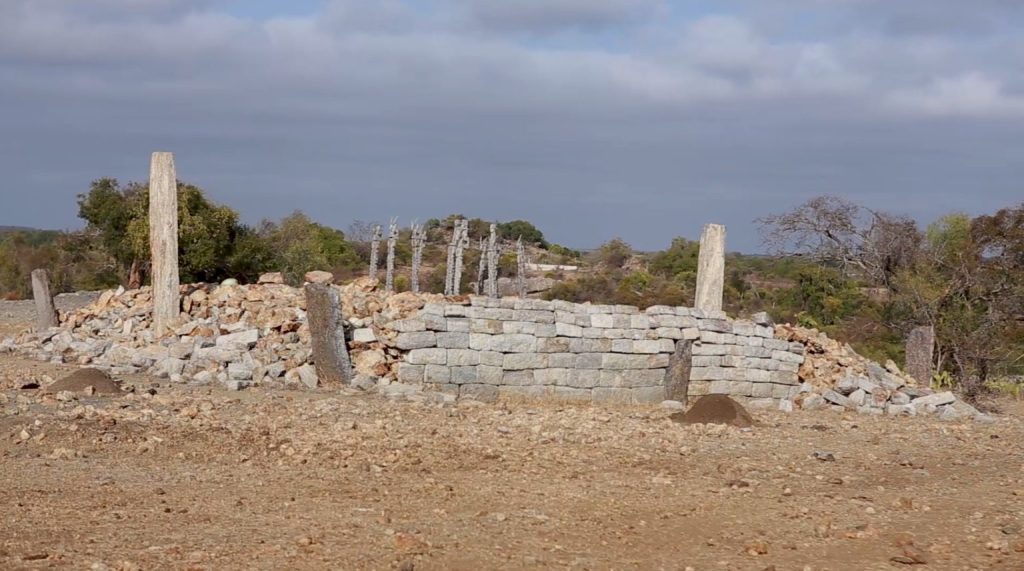
In the rural commune of Maniry, located in the district of Ampanihy, Atsimo Andrefana Region, the village of Rehambohitse Ambony is at the center of a conflict between local traditions and mining operations. The Australian company Evion Group (formerly Black Earth Minerals) plans to mine graphite there. Nevertheless, the presence of Mahafaly tombs, considered sacred by the local community, raises concerns about the project’s impact on cultural heritage and ancestral rites.
People in Rehambohitse Ambony strongly oppose graphite mining project in their area. “No matter how many billions or millions of Ariary they offer us, we won’t give up our land for graphite mining,” they assert with determination. Their main concern is protecting their ancestral heritage, especially the sacred tombs of the Mahafaly.
Among the leaders of this resistance is Mandrohivelo, a village chief in his sixties, who expresses the general concern. “We will never accept this situation. This is our land, where our ancestors have rested for centuries. No matter how much money or zebu they offer, our culture cannot be bought,” he insists in a serious tone, reflecting the fear of seeing an essential part of their identity disappear.
The mining project is being carried out by the Australian company Evion Group. The company has four exploration permits covering 10,880 hectares, acquired in 2001, as well as eight mining permits covering 11,520 hectares, obtained on July 20, 2005. However, questions have been raised about the legality of its mining activities, as its environmental permit (No. 498/03/MINENV), issued on September 5, 2003, only covers the mining of labradorite, not that of graphite. This situation is fueling tensions and raising questions about the legal framework for the planned extraction.
A mining project in the heart of a sacred site
Among the Mahafaly people, tombs are fundamental elements of cultural and spiritual heritage. “These structures are not just burial sites, they embody the memory of ancestors, a spiritual connection that nothing should alter,” Philibert, a village resident, explains.
In the center of the village stands a Mandorave, a tree sacred to the Mahafaly, which traditionally serves as a place of gathering and consultation. It is in the shade of the tree that the inhabitants of Rehambohitse Ambony meet to discuss the future of their territory in the face of the Evion mining project. The stakes are considerable : the graphite deposits identified by the company are located directly beneath these tombs, making their preservation incompatible with mining.
Obstacle to obtaining environmental permit
The Mayor of Maniry, Sambo, confirms the situation: “The company has already conducted surveys in the village of Rehambohitse. It is beneath the graves that it has identified the best graphite vein. At present, these graves constitute a major obstacle to obtaining the environmental permit required for mining operations.” ONE says it is following the case closely.
Tsilavina Rabefarihy, head of the USIDE unit at ONE, specifies: “The company submitted additional studies to obtain the environmental permit for graphite mining in the municipality of Maniry. However, it then decided to halt the project assessment for social reasons, particularly in relation to the tombs.”
In the interest of balance and transparency, several attempts were made to obtain Evion Group’s version of events. However, the company refused all interviews and did not respond to requests from Malina journalists. But according to Malagasy law, specifically Decree No. 2006-910 of December 19, 2006, on the environmental management of mining projects, any mining operation involving the destruction of a cultural site, such as a tomb, must obtain prior approval from the local community and the relevant authorities. In the absence of such consent, any attempt at mining could be considered a violation of the rights of local populations and the legal provisions in force.
A clash of values: when the economy tramples on fundamental human rights
In the village of Rehambohitse Ambony, 51 graves are directly threatened by graphite mining operations carried out by the Australian company Evion Group. The mayor of the municipality, Somon, confirms the complexity of the situation: “This vein of pure-quality graphite is located directly beneath these graves, a crucial factor that has sparked intense debate between the company and the local community.” During an initial meeting between Black Earth Minerals and the Rehambohitse community on September 22, 2021, “the company assured that no exploration would be carried out near the tombs. As compensation for the construction of the borehole, it had offered the community two zebu cattle and a sum of MGA 600,000.” This information is contained in a meeting report presented by the village chief.
However, this promise proved to be short-lived. A few months after making this commitment, the company returned with a new offer: MGA one billion per tomb affected. This proposal immediately provoked a strong reaction from the inhabitants. “Faced with this proposal, the community expressed its firm opposition,” Sambo testifies.
Respect for the 100-meter exclusion zone: a legal and cultural obligation
The article 130 of the law n° 2023-007, concerning the revision of the Mining Code of Madagascar, establishes strict restrictions concerning the areas prohibited for mining: “Without prejudice to any specific restrictions, no exploration or mining work may be carried out on the surface within a zone of one hundred (100) meters, known as the prohibited zone, unless it can be demonstrated that the mining permit and/or authorization was granted previously.
1. Around properties enclosed by walls or equivalent structures or any other boundaries customary in the region concerned, villages, groups of dwellings, wells and springs, religious buildings, burial sites, and places considered sacred or taboo, without the written consent, as applicable, of either the owner or the relevant CTD authorities;
2. On either side of transport routes, water pipes and generally around all public utility works, archaeological sites, places of worship, classified cultural and tourist sites and engineering structures, without authorization from the Minister responsible for Mines, after approval by the competent authorities.”
This provision aims to protect not only the environment, but also areas of high cultural and social value. Razafiharison Andriamanantena, anthropologist and member of parliament for Madagascar elected in the district of Ampanihy, strongly supports this law, highlighting the importance of burial sites in Malagasy culture. “These tombs are not simply monuments,” he emphasizes. “They represent a deep attachment to the ancestral world, a duty of remembrance, and unwavering respect for those who shaped our culture.” For him, the mobilization of the inhabitants of Maniry goes beyond simple economic opposition and reflects “the preservation of a cultural and historical identity that deeply binds the population to its ancestors.”
In this way, communities in Maniry in the south are facing a lack of respect for fundamental human rights. Promises of development clash with the reality of daily life marked by precariousness and neglect. While compensation committees struggle to fulfill their role and companies shirk their responsibilities, local populations remain in search of answers and justice. At the cost of development, how many more sacrifices will have to be made?
By Antsamalala Felana Fitiavana and Ismaël Mihaja