




Bloody clashes erupt regularly between residents of several villages in the commune of Ambatosia, Bealanana district (Sofia region), during every rice harvest season. At the heart of the violence lies an old, unresolved land dispute—compounded by corruption, misinformation, and the absence of effective state authority.
Communities from Matsaborimena (Fokontany Ambalabe Mahafahana), Beanantsindra, Anolakely, and Ambohimitsinjo have been fighting over rice paddies for years. These recurring tensions often escalate during harvest periods, as each side claims ownership and access to the land. The resulting state of constant conflict casts a heavy shadow over the social and economic life of the region.
On May 31, 2020, a 60-year-old man was killed by security forces in Matsaborimena following a violent clash between villagers from Matsaborimena and Beanantsindra. Several people were injured, and ten others were placed in pretrial detention in Antsohihy. This tragic event, which took place in the midst of the harvest, is only the latest in a long string of annual confrontations, explained Djaosera Albert Marie, deputy chief of the Bealanana district and, at the time, head of security enforcement:
“It’s a conflict that recurs every year, but this time, the violence reached a critical level. The dispute centers on the rice harvest. The villagers are fighting over a piece of land that has been contested for years. The residents of Matsaborimena had obtained authorization from the Prosecutor to proceed with the harvest. The people of Beanantsindra opposed it, which led to violent skirmishes involving machetes, sticks, and stones. It was in the midst of this chaos that a man lost his life.”
According to local authorities, around 700 people from Beanantsindra attacked a group of 40 residents from Matsaborimena. The latter claim to have obtained a court ruling granting them the right to cultivate and harvest rice on the disputed plot. They report being systematically attacked whenever they enter the rice fields and accuse villagers from Beanantsindra of forcibly looting their harvest on that day.
Randriamihevitra, a resident of Matsaborimena, testified: “We were harvesting the rice when they attacked us with machetes and threw stones. We had no choice but to call in the security forces to avoid a bloodbath. This time, the violence spread beyond the fields and into the village itself—our homes were looted, our possessions destroyed. Yet we won this case in court, but they keep fighting to reclaim this land.”
This land dispute, emblematic of many other rural tensions across Madagascar, highlights the failure of land regulation mechanisms and the weakness of the state in the face of corruption and local manipulation. Until structural solutions are implemented, the violence is likely to persist.
Land Dispute or Rice Conflict
A 225-hectare plot is at the heart of the dispute between the residents of Matsaborimena and those of Beanantsindra. Each hectare yields an average of 200 bags of unhulled rice per year. Representatives of Beanantsindra claim to have started cultivating rice on the land as early as September 2019, asserting ownership of the plot. Their attempt to harvest it was blocked by residents of Matsaborimena and by the security forces, triggering the unrest.
According to some testimonies, the case is tainted by corruption involving, notably, the district chief and the prosecutor. Manantena Jean Venel, a resident of Ambohimitsinjo, explains: “The bailiff Ravelo is distorting the content of the court order. What’s written doesn’t match what he’s claiming. He says that we—the group led by Lehitranga, made up of people from Beanantsindra, Anolakely, and Ambohimitsinjo—do not have the right to harvest the rice we cultivated, while Njoky’s group in Matsaborimena does. That makes us angry. Every time we try to harvest, we’re threatened with firearms, and we’re told it’s by order of the prosecutor. We believe the unrest is rooted in corruption involving the bailiff and the prosecutor. We’ve heard that the people of Matsaborimena each receive 600 bags of rice, and that seems credible. It’s as if the court order is the only thing that matters now, even though we hold legal documents proving our rights to this excluded land.”
The Residents of Beanantsindra First Attempted to Harvest in April 2020
The residents of Beanantsindra had made an initial attempt to harvest in April 2020 but were prevented from doing so by security forces, citing a prosecutor’s order that banned any harvesting pending the court ruling. However, according to Noelin, a resident of Ambohimitsinjo, they returned before the trial date without any official documentation, which was seen as an abuse of authority.
“The security forces present that day had all signed a statement confirming that neither party was authorized to harvest before the hearing scheduled for May 20. That was the date when it was to be decided who the rice belonged to. But on May 19, they came back to collect the harvest, claiming they were acting on the prosecutor’s orders…”
However, the prosecutor at the Antsohihy court, Randriamamy Fanomezantsoa Eddy, denies any involvement:
“The prosecutor does not have the power to issue an order. That is solely the prerogative of the court president. The order in question, issued by the magistrate, is what caused the misunderstanding. I was not informed in time because it was a routine case. Only after the conflict broke out did I send officials to the site. This was not an intentional confrontation between the two groups, but rather a misinterpretation of the order. The beneficiaries believed it gave them the right to harvest all the plots, which led to the clashes. A boundary demarcation mission was initiated by the district chiefs from both camps shortly before May 31.
However, the land representative from the Matsaborimena group was threatened by members of Beanantsindra, which prevented the continuation of the work. In the event of attacks or unrest, our duty remains to enable the security forces to protect people and their property. On May 31, those who attacked were clearly under the influence of narcotics.”
Asked to provide her perspective, the president of the Antsohihy court, Rabendrainy Hanitra Nadia, declined to comment, referring instead to Judge Ihanja Gino. The latter simply stated that it is the role of the prosecution to communicate publicly on ongoing judicial matters when necessary.
Who Are the Real Owners of These Plots?
In 1958, forty people assisted by zebus were paid to clear the “Matsaboriben’i Lanilezana” plot in the fokontany of Ambalabe M. People from several fokontany, including Beanantsindra, were mobilized for the task. The land conflict tearing apart the commune of Ambatosia in the Bealanana district actually dates back to 1976.
“We, the residents of Matsaborimena, have been victims of this injustice since 1958, and it was only in 1976 that the people of Beanantsindra began acknowledging the debt we had established,” said Njoky, a resident of Matsaborimena. “Reconciliation efforts were initiated by the community, but no investigation ever confirmed that only the residents of Ambalabe M were the rightful landowners. Dissatisfied, they filed a complaint with the Bealanana federation. The situation had initially been settled in favor of the fokontany Ambalabe M. The case was brought before the Analalava court in 1986, and a judgment was issued in 1992, but the Lehitranga lineage, represented by the residents of Beanantsindra, lost again. We demanded their removal. They eventually agreed to leave and signed a document acknowledging they were not the rightful owners. However, they returned to court in Analalava, and without a direct confrontation, a new ruling was issued declaring Beanantsindra the owner. We were stunned by this reversal. We then filed an appeal in Mahajanga. Again, without confrontation, a judgment was quickly delivered against us. We eventually appealed to the Supreme Court and obtained an order allowing us to use the land, but we are constantly obstructed.”
On their side, the Beanantsindra camp also claims ownership of the land. According to them, it had never been cultivated in 1976, which would mean it belonged to the State, making it eligible for public use upon request. Velonatrefona, a resident of Ambohimitsinjo, explains:
“We submitted a request to the State. The authorities came to inspect and measure the land, and we gradually began the clearing work. It was only in 1977 that the residents of Matsaborimena claimed the land belonged to their ancestor, Dadilahina. However, after verification with the land services, it was confirmed that we were the owners because we had filed an official request that granted us usage rights. The matter then had to be settled in court. We consulted the land office again, which assured us the land was ours and provided us with proper documentation. We presented these documents to the court and, after several verifications, the court ruled in our favor. We are 55 landowning families, but only 25 land registry certificates were issued in 2012. We have completed all the administrative steps necessary to legalize our rights over this land. It is inconceivable to us that, when we come to harvest our rice, we are stopped by security forces—something that, in recent instances, has resulted in the loss of our loved ones’ lives.”
“55 Titles”: What Are the Factors Perpetuating the Conflict?
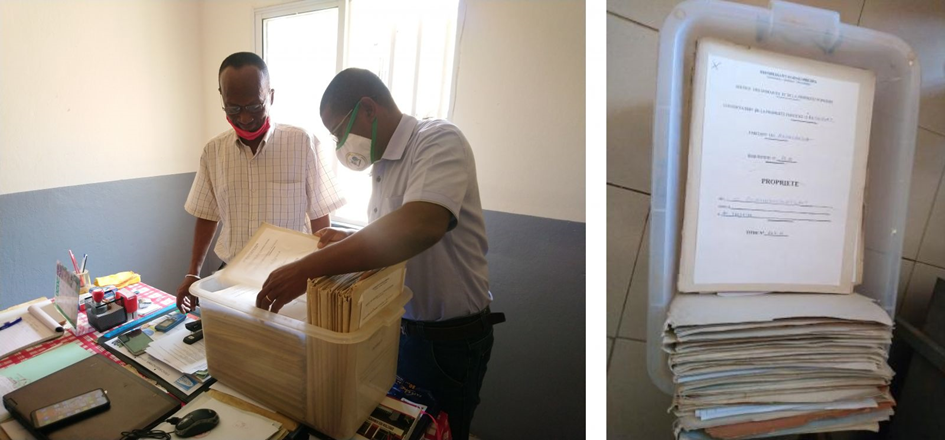
“Declarative titles” are issued to individuals who have submitted an official request for state-owned lands after completing all the required steps with the land service. According to officials at the Antsohihy Land Service, these titles confer legal ownership under Law No. 60-004 of February 1960 concerning the national private domain. On May 11, 1976, the residents of Beanantsindra filed a request with the competent authorities in Antsohihy, registered under number 16/76, regarding a plot called “Reban’Andilamborona Lanilezana amparihin’ny pont.” Fifty-five people were grouped as joint owners, and as many declarative titles were issued.
“The acquisition of their titles was legal and met all requirements,” says Tombo Evariste, head of the Antsohihy Land Service. “According to the file in our possession, they completed all necessary steps: public posting, recognition, approval by the district chief and the competent authorities at the time.”
Their request initially received support from the Ambalabe M community, represented by Andriamatoa Kalozara, on July 9, 1994. However, this support was rejected by the land inquiry commission, and the Mahajanga region canceled this approval on May 22, 2001.
“Only those who have completed all regulatory steps obtain a legal right to the land. Any acquisition contrary to these rules is immediately considered fraudulent,” explains Andrianarison Benjamin, head of the Antsohihy land district. He adds, “Currently, it is common for legal titleholders to be prevented from using their land. This is the main source of land conflicts. It causes serious social problems and could even have major economic repercussions. Only a judicial decision can settle this and prevent both parties from exploiting the land.”
According to Me Raveloson Fiharea, lawyer and land representative, the conflict opposes two visions over the same land. He claims the Beanantsindra family, notably the Lehitranga lineage, the main instigator of the conflict, benefits from the situation by deceiving their own neighbors. He also mentions a former employee of the Antsohihy land service, Zafisoa Juliana, close to this family, who allegedly facilitated the obtaining of the titles.
The Antsohihy prosecutor, Randriamamy Fanomezantsoa Eddy, confirms that this point was raised in WTO reports during the May 31 clashes in Matsaborimena. He emphasizes that this suspicion prolongs the conflict and will require lengthy investigations to verify.
Jaomisy, a resident of Matsaborimena, accuses collusion between the State and the Beanantsindra group and asserts that the influence of their close employee in the land service explains the persistence of the conflict. “We believe this is a case of corruption, because we initially won and then lost. We appealed to higher authorities but to no avail. The descendant of this land service employee is the one who obtained the land titles,” he denounces. Yet, Juliana Zafisoa’s certificate of appointment indicates she began working in 2013, ten years after the first declarative titles were issued.
On the Beanantsindra side, Zafy Julienne rejects the idea that it concerns the same plot. She explains, “These are different lands, located on either side of the Lanilezana bridge, but they claim they are one. If Ambalabe M indeed grazed cattle in 1958 on the plot to the right of the bridge, it was only in 1976 that we began exploiting the plot to the left, which had been unused. Ambalabe M contested this in court, and we lost. We then returned to the land office, which confirmed the land was ours. We had the plot surveyed, which is separate, and produced official documents to the court, allowing us to win.”
Prosper, retired from the Antsohihy land service and former member of the inquiry commission on Beanantsindra’s land request, reports: “The 55 title requests were grouped. A field recognition was organized with hearings of both parties. The conflict arose during the clearing of the land because the plots overlapped. During the 1991 field investigation, we found that the plot requested by Beanantsindra encroached on Ambalabe M’s domain, which justified continuing the case. Once the declarative title is obtained, one is considered the owner. These titles were issued in 2003.”
Fraud and Extortion of Money
The families involved in the land dispute are also suffering financial losses due to scams, according to the testimony of Ralaivao Olivier. A man claiming to be able to resolve all issues came to Matsaborimena but disappeared without a trace:
“A certain Rabenasolomanana Arthur, originally from Bealanana, claimed he could handle the case. He collected a significant sum from the fokonolona, even selling property, totaling about six million ariary. But nothing was done. When the May 31 unrest broke out, he was contacted but vanished and remains missing to this day.”
In May 2020, the chief of fokontany of Ambohimitsinjo received a letter dated April 29, 2020, requesting the cessation of hostilities in his area related to the Matsaborimena land dispute. This document, signed by Rabenasolomanana Arthur, purported to come from the “Association for the Promotion of Human Rights (APDH).” He had also sent a letter to the residents of Beanantsindra, Anolakely, and Ambohimitsinjo, calling for a meeting regarding the dispute. He claimed to have reviewed their files but said the coronavirus pandemic prevented any immediate action. He assured that he could resolve the conflict if the residents of Matsaborimena returned the money collected by the fokonolona, suggesting a possible agreement.
Me Raveloson Fiharea revealed that Rabenasolomanana Arthur is known as a “fixer” within the judicial system. Few people in Bealanana truly know him, and the Antsohihy prosecutor is unaware of his existence, but procedures to locate him will be initiated.
Since this affair, the population of Matsaborimena has been divided in two. Currently, neither Beanantsindra nor Matsaborimena can exploit the lands in question.
Just and Lawful…
The debate between what is “just” and what is “legal” is a recurring issue in land disputes. The Antsohihy prosecutor, Randriamamy Fanomezantsoa Eddy, explains that this disagreement precisely opposes these two concepts. “Historically, Ambalabe M is the legitimate owner, but Beanantsindra holds the legal titles. It is unclear whether these titles were obtained through proper procedures.” To him, this seems unlikely, as many steps must be followed to obtain a title.
“When the titles were acquired, Ambalabe M did not provide support. So one may wonder whether Beanantsindra respected all the procedures or if it is a case of ‘fraudulent registration.’ The residents of Beanantsindra know well that their title is ‘unassailable,’ which grants them legal security. Under these conditions, this conflict could last another twenty years.”
Officials from the Antsohihy Land Office have already provided explanations regarding the steps taken by Beanantsindra to obtain their title, as well as Ambalabe M’s support, which will serve as the basis for a thorough investigation by the prosecutor.
The governor of the Sofia region, General Lylison René de Rolland, emphasizes that land conflicts are at the root of rural violence, particularly in the Bealanana district:
“I cannot judge who is right or wrong. My appeal is that only the true owners should receive the land, otherwise the conflict will be endless. It is sad to see that residents no longer trust the State and turn to the ‘sojabe’ (traditional chiefs), which is illegal and often leads to imprisonment.”
The Population Faces Economic and Social Hardships
Currently, neither Beanantsindra nor Matsaborimena, the parties involved in the land dispute, are authorized to access the contested lands. The order that caused the issue was suspended, allowing the residents of Matsaborimena to harvest the rice, according to Antsohihy prosecutor Randriamamy Fanomezantsoa Eddy. The harvests are then entrusted to the commune, which seeks others to carry out the reaping. No access to the lands is permitted until a final judgment is rendered by the courts.
The Matsaborimena team claims to be exhausted by this conflict. Njoky states that every harvest season is synonymous with suffering, but this one has been particularly severe, plunging the community into famine:
“We are in great distress, completely lost. We ask the authorities and officials to seriously investigate this matter. We are suffering, many are sick, there is nothing to eat, money disappears because of the misery these conflicts have caused.”
Jaomisy, also from Matsaborimena, says they even filed a complaint with the “Grievance Service” in Ambohitsirohitra, Antananarivo, but to no avail so far. Their wish is clear:
“We want to reclaim our land as the true owners so that this conflict ends definitively.”
On the Beanantsindra side, residents also feel severely affected by this unresolved affair. Many depend on the annual rice production, which they sell or use to supply other towns. This harvest is their main source of income, explains Manantena Jean Venel:
“Today, we have lost rice, members of our families have died, others are in prison. The higher authorities do not oversee the local situation, and everyone does as they please, which completely disrupts our living conditions.”
For the Bealanana district chief, Ndeha Sylvain, resolving the conflict requires the intervention of all concerned parties to prevent further unrest and violence. He calls for cooperation between the judiciary and land services. This conflict is one of the longest and most violent in the Sofia region. Officials pass the responsibility back and forth, claiming to be newly appointed and unaware of the history.
Article written by Judith Rakotovao.