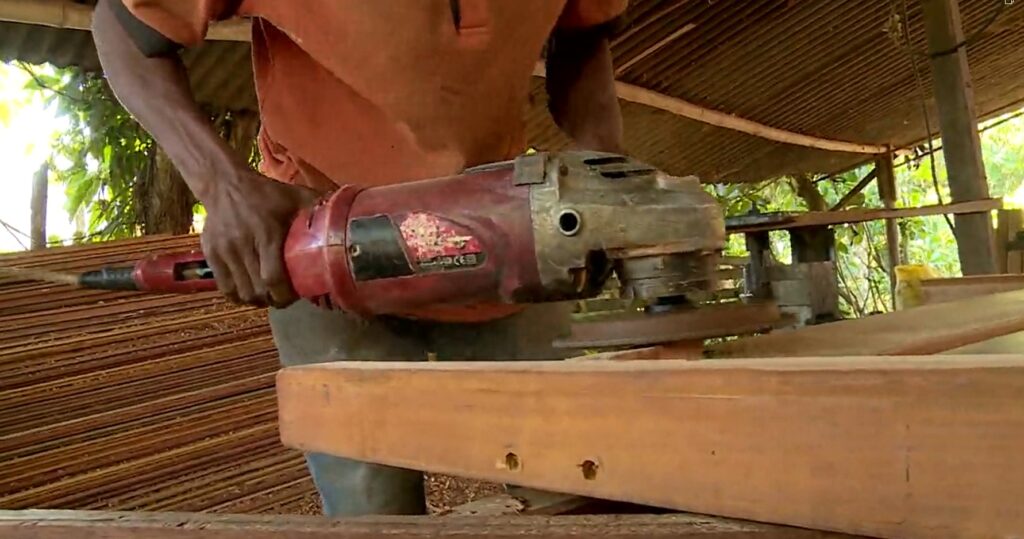





Maroantsetra, in the north-east of the Analanjirofo region, is known for its extensive forests of precious woods, particularly rosewood. Listed in Appendix II of the Convention on International Trade in Endangered Species (CITES), rosewood has been the target of massive illegal logging for several decades, financed by a network of local and regional traffickers. The law seems to have no hold on this rosewood mafia: the network is sprawling and aggressive.
“It’s too dangerous! Our guides block our way. As we stand on the outskirts of Masoala Park, some thirty kilometres from Maroantsetra, the sounds of chainsaws call out to us from far and wide. Somewhere, lumberjacks are cutting wood. This noise of chainsaws in the middle of Masoala is not insignificant: they are undoubtedly traffickers, as cutting is strictly forbidden in protected areas. In the Maroantsetra district, rosewood traffickers form an all-powerful mafia, and if our guides are frightened by the idea of meeting them, it’s because they have a reputation for being aggressive, armed and violent.
850 chainsaws clear 8,500 ha of trees
Masoala National Park, the Mananara Biosphere Reserve and part of the Makira Natural Park are the hardest hit by the illegal cutting of precious wood, according to studies by the NGO Traffic, which works on a global scale on the wildlife trade in the context of conservation and sustainable development [1]. “90% of wood is destined for international trade and only 10% for the domestic market. The exploitation of precious woods has been banned since 2010, but despite this ban, trafficking continues”, emphasises the Traffic report.
These practices have continued, and in 2022 even took on hallucinatory proportions with the use of sophisticated equipment. These chainsaws are plentiful throughout the Maroantsetra district, and have become the tools of choice for traffickers. Clovis Razafimalala, who chairs the Lampogno platform, which brings together a dozen environmental associations, is concerned that illegal logging is increasing with the use of these powerful tools: ‘In just one week, a logger can cut up to 10 hectares of trees. In 2020, the Lampogno platform counted more than 850 chainsaws in the Maroantsetra district alone, or around sixty per commune. ‘This represents the possibility of felling around 8,500 ha of trees in a week (…) With a chainsaw, you can work very quickly and leave the site quickly’, says Razafimalala.
In addition to its high destructive power, the chainsaw also has other particularly devastating disadvantages: “using a chainsaw requires more space: you have to clear the immediate surroundings of the tree to be felled, needlessly cutting down other trees. The blades of chainsaws are thicker than those of a traditional woodcutter’s saw, so the number of planks obtained per tree is reduced. You have to cut down many more trees to obtain the same number of planks as with a traditional saw”.
At the Maroantsetra market, a Stihl chainsaw was sold for 2,600,000 Ar in November 2022. Traders say they are not subject to any form of regulation when selling this cutting equipment. Most of the time, the customer supplies the tool to the woodcutter in exchange for a certain quantity of boards or planks to be delivered. ”Once the service has been completed, the chainsaw becomes the property of the woodcutter, who can use it as he wishes. He can hire out his services to other customers or work for himself,” says Razafimalala
Rosewood is everywhere
The Maroantstrra timber market illustrates the immediate result of this massive exploitation. In this famous ‘Tsenan’ny hazo’, rosewood is everywhere: raw wood pieces, worked furniture, decorative objects, various utensils and instruments. Apart from cutting in the forest, trade and the transport of raw or finished pieces are also carried out freely. It is always possible to obtain rosewood from carpentry workshops, if the price is right. According to the Madagascar National Parks (MNP), which manages Masoala National Park, Maroantsetra has some 200 sawmills and carpentry workshops: ‘the exploitation of wood (rosewood, editor’s note) is a source of income and even a means of subsistence for a large part of the population’, explains Jean Fidélis Rakotomanana, acting director of the MNP in Maroantsetra.
Wood is the local raw material, as this northern and north-eastern part of the Bay of Antongil is home to one of Madagascar’s last great primary forests. The landscapes of the Makira Natural Park, one of Madagascar’s largest protected areas with 371,000 ha managed by the Wildlife Conservation Society (WCS), and the 235,000 ha Masoala National Park administered by the MNP, are a reflection of this natural wealth. The existence of these protected areas has not deterred traffickers. Nor has the ban on cutting, harvesting, transporting and exporting rosewood in force since 2019[1]. Despite these prohibitions imposed by law, 650 rosewood trees cut without a cutting permit or exploitation authorisation were apprehended by the Maroantsetra forest cantonment service between February and November 2022.
Illegal logging does not only serve local customers, as clandestine exports are said to be regularly organised from villages on the outskirts of protected areas and close to a river or sea route: ‘There is a real network, from the logger to the client’, points out Rakotomanana, acting director of the Maroantsetra MNP. It’s a network that works like a beehive: woodcutters who do the cutting, dockers who transport the wood, guards who ‘secure’ the traffic and who are suspected of being armed, and the boat crews.
The rosewood comes from the surrounding forests, cut in the middle of the night and transported by boat to other destinations. Rakotomanana, acting director of the Maroantsetra MNP, explains the traffickers’ modus operandi: “Most of the villages around the protected area are located near a river or by the sea. There’s a lot of scope for taking timber on board. These are transformed into planks or half planks and can be transported on the backs of men to the boats. These boats then leave for Mananara, Soanierana-Ivongo or Sainte-Marie. On the sea, control is more difficult (…) The wood is generally destined for illegal export”.
In Antôraka, one of the small fishing villages close to where the shipments of rosewood are loaded, the president of the locally managed fishing area confirms this traffic: “The wood is transported by pirogues to large boats anchored offshore during the night. These people are very well equipped: as well as chainsaws, used for cutting, they use powerful torches or generators to light them up. They have scuba-diving equipment, and some people claim that they are also armed”.
It’s a well-oiled machine that takes advantage of the lack of resources at local level. ”We don’t have enough human and material resources. Going out to meet traffickers in these conditions is dangerous, if not suicidal”, laments Aurélien Raberiaka, head of the Maroantsetra forestry unit. The same is true of the Maritime and River Port Agency (APMF) in Maroantsetra, whose director, Dany Gérard Azendry, confides: ‘Due to a lack of material and human resources, controls at sea are difficult’. Moreover, the APMF only checks whether the boat meets the technical criteria required for navigation and issues the appropriate permit to the owner, ‘our remit does not include the cargo on board’.
Inside the forests, the carnage continues. Environmental organisations working in the region have reported a number of infringements, including the felling and exploitation of forest products, illegal occupation within the buffer zone of the Masoala protected area, the felling of rosewood in the core area of the Ambinanitelo forest, and the transport of forest products into town at Andranomena Andavania and by sea at Maraomby. Whistleblowers inform these organisations of any infractions. ”Informers alert us when there is suspicious logging (…) But these operations are always carried out in the middle of the night. Our agents can only monitor discreetly and report back”, Clovis Razafimalala laments. The authorities and protected area managers often arrive on the scene too late. In the best of cases, the wood is left behind, but the culprits cannot be found.
Unrestricted sales, near-permanent exploitation, particularly invasive traffickers, authorities with no means of deterrence: who can stop the rosewood mafia in Maroantsetra ? Jean Fidélis Rakotamanana of the MNP refers to ‘political and ethnic pressures that hamper the application of the law’. The justice system is reportedly not very fussy: ‘even when caught red-handed, the perpetrators, once brought to justice, only receive light sentences. In addition, the issue of the rosewood trade remains an open debate in Maroantsetra. ”If rosewood can be sold in Antananarivo and Toamasina, why shouldn’t it be sold in Maroantsetra, one of the main producing regions and where its use is almost traditional?
The Analanjirofo Regional Director for the Environment and Sustainable Development (DREDD) told us that “in the Analanjirofo region, authorisation to use old stockpiles has not yet been granted. All operators have to declare their stock before they can use it”. However, for the districts of Maroantsetra and Mananara Avaratra, the data from the Analanjirofo DREDD is clear: no logger with a logging permit has made a stock declaration to date (April 2023).
Popular vindictiveness
But another phenomenon is exacerbating the situation: the resistance of a certain faction of the local population who do not hesitate to resort to violence in the event of repression. One of our guides recalls: “Recently, the inhabitants of Maroantsetra have shown themselves to be more inclined to violent mob violence. The homes of police officers were set on fire by angry mobs. In another case, a logger was imprisoned for illegally transporting precious wood. All the loggers in the town demonstrated for his release. The reaction of the population is said to be a source of concern for the local authorities, making them more hesitant about cracking down on illegal trafficking. This situation is confirmed by the head of the Maroantsetra cantonment.
At the Maroantsetra tax office, Jaona (not his real name), an agent, sums up the situation: “they tell you clearly: either you do your job or you make money. Often, you’re on your own. There are no resources, either financial or human. In the end, you wonder why you needlessly make enemies when you can’t work under normal conditions anyway. Faced with this situation, the authorities either turn a blind eye or choose to collaborate”.
Illegal occupation of protected areas
Illegal occupation of protected areas is also one of the causes of the massive exploitation of Maroantsetra’s precious woods. In the rural commune of Ambanizana, the dilemma between the survival of the population and the need to preserve the forests is creating land conflicts. The extension of the boundaries of the national park has restricted the area available for cultivation, with significant impacts on the daily lives of farmers.
The mayor of Ambanizana, Maurice Andriamefa, explains: “The boundaries of the national park have been extended three times. Crops have been included in the new boundaries. However, access to protected areas is regulated. The former owners of these fields want to continue farming them. The explanations given by those in charge of protected areas to justify the extensions do not satisfy the public”.
In fact, the Makira Park management plan provides for communities to remain within the protected area. They live in controlled occupation zones (ZOCs) and work in sustainable use zones (ZUDs), which are provided for by law. Movement within the protected area is therefore possible, “but these movements can easily lead to confusion. It’s not out of the question that ill-intentioned people might take advantage of this opportunity to move within the park to infiltrate and enter protected areas illegally”, worries the mayor of Ambanizana.
In addition, some families whose land was included in the new protected area boundary ‘have not received any new land or financial compensation’, according to the mayor of Ambanizana. However, these people, who claim to have been adversely affected by the extension of the protected area, refused to meet journalists.
In the case of Ambanizana, the protected area currently covers 85% of the surface area of the commune: arable land is limited, yet the number of inhabitants is increasing. Ambanizana: “Because of the increase in the population, the arable land is becoming increasingly limited. The fields traditionally used to grow rice, vanilla and cloves are no longer enough for people to live on. So, some people are clearing the forest to free up an area of land in the hope of owning it in the future. Others cut down wood to sell it and buy food.
The rosewood mafia still holds sway over this part of the island and imposes its law. With illegal felling fuelling the trade, the risk of mob violence, illegal occupation, inadequate means of control and the poverty of the most vulnerable, Maroantsetra’s precious wood may not last long.
[1](1) Note-instruction n° 001/MEDD/MI of 29/01/2019, explanatory note n° 144/19/MEDD/SG of 19/02/2019, note-instruction n° 003-21/MEDD of 29/01/2021
[1] ‘L’Ile aux Bois – Le Commerce de Bois de Rose et de Bois d’Ébène de Madagascar’ (TRAFFIC, 2016)