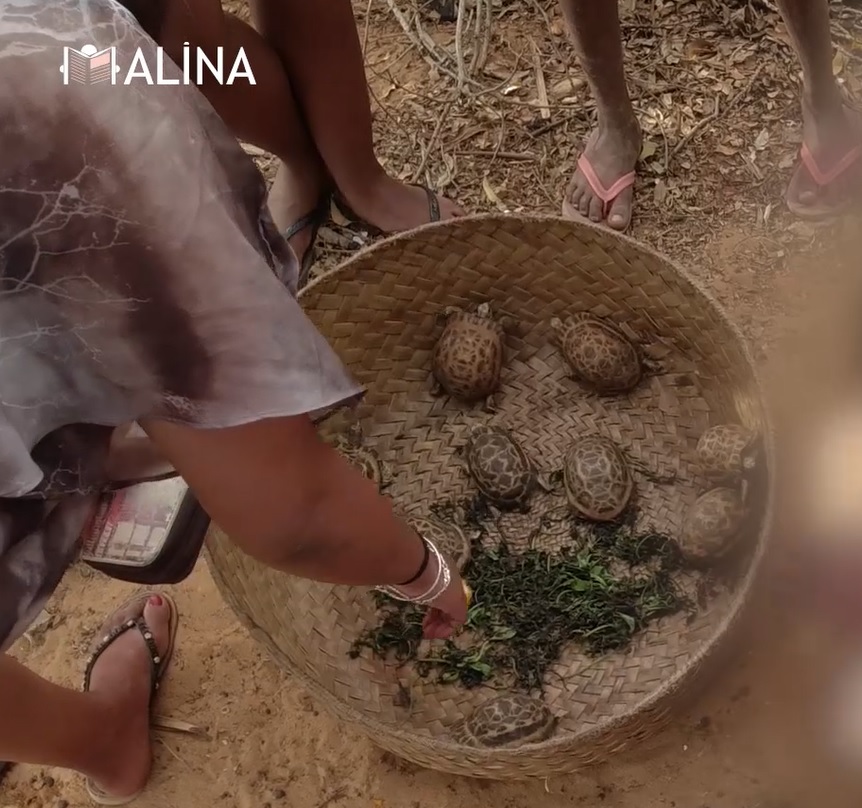





According to the NGO Traffic, which monitors the trade of wild species worldwide, 21,000 Madagascar turtles were trafficked between 2018 and 2021. This illegal exploitation originates in southern Madagascar and extends like a sprawling network abroad. In Atsimo Andrefana and Androy, we ventured onto the turtles’ lands, now colonized by traffickers.
It is noon in Mahavatsy, Toliara II. In a small market eatery, Joseph approaches discreetly: “If you want to taste turtle meat, it’s 50,000 Ariary for an adult specimen,” he whispers, aware that he is sharing something illegal. Joseph refuses to introduce us to his suppliers: the sale and consumption of turtles, a protected species, is prohibited.
Later, in Mangily, a fishing village and tourist spot about thirty kilometers from Toliara, Toky, a runner for beachside restaurants, approaches tourists: “We offer sokake dishes at 45,000 Ariary and sea turtle dishes at 50,000 Ariary.”
Once subject to “fady,” a local customary taboo, turtles were among the animals that many neither touched nor consumed. In southern Madagascar, turtles were attributed some mystical but also healing virtues, so they were protected by tradition and respected for their benefits. However, for several decades now, turtles have been the victims of a true plundering. Eonintsoa, animal caretaker at the Mangily Turtle Village, explains: “In the past, even touching a turtle was taboo for the people of southern Madagascar. But today, turtles represent far too much money at stake. Since poverty severely affects the southern part of the island, the population survives by poaching turtles deep in the forest to sell them.”
From 12 Million Turtles to One Turtle per Hectare
Beyond the peasant who illegally collects turtles in the forests, the trafficking of these animals reaches staggering levels. It is organized by traffickers whose sprawling networks extend far beyond Atsimo Andrefana and Androy, the preferred habitats of these endemic Malagasy species. Hunted for consumption or as pets, they fall prey to criminals of all kinds: impoverished farmers, seasoned traffickers, complicit authorities, and unscrupulous buyers.
Madagascar is home to nine turtle species, five of which are endemic to the island. The scale of this illegal trade is such that while WWF estimated the population of radiated tortoises at 12 million individuals in 1990, “there is now barely one radiated tortoise per hectare,” states Soloantsoa Mampionona Jeannin, Regional Director of Environment and Sustainable Development in Androy.
Radiated tortoises (Astrochelys radiata), locally known as sokake, are found exclusively in the southern part of the island and are the most sought after by local consumers. In Mangily, Toky, a runner for beachside restaurants, says: “Fresh meat, prepared, dried, or smoked, is available by the kilo, just as you can buy individual turtles, alive or dead, for between 20,000 and 50,000 Ariary.” In Toliara and surrounding areas, this rare delicacy is called “the special.” The market is lucrative for traffickers. Our sources report that the average price a collector pays for a radiated tortoise is 30,000 Ariary. Upon resale, these turtles fetch between 10,000 and 200,000 Ariary each.
For export orders, angonoka tortoises (Astrochelys yniphora), endemic to the Baly Bay and Soalala area, are bought for 5,000 Ariary each. Collectors resell adult turtles for between 300,000 and 400,000 Ariary apiece, while juveniles fetch around 800,000 Ariary. The juveniles are more expensive because their small size allows them to be transported in suitcases. However, prices can reach exorbitant levels: our sources indicate that on European and Asian markets, an angonoka can be worth up to 800 euros.
Despite controls, sanctions, and massive awareness and deterrence campaigns, traffickers do not back down. The lure of profit is so strong that even the average internet user takes interest. Indeed, a few simple searches on social media platforms like Facebook reveal offers for sale or orders.
A Park at the Mercy of Poachers
Tsimanampetsotse National Park is one of the areas suffering from poacher invasions : “The holiday periods are the most sensitive, as people demand turtle meat during these times. Orders even come from Antananarivo,” says Beberon Randriamampionona, Sector Chief of Madagascar National Parks (MNP) in Beahitsy. Illegal collectors operate in two ways: trafficking turtles along the coastline and trafficking turtles across the Mahafaly limestone plateau, which houses the national park.
For land trafficking, traffickers avoid national roads where they risk being stopped by law enforcement. They prefer to cross the limestone plateau and enter the park. “Poachers break in about 240 km from the park’s boundary. They cross the park on foot for four days and five nights, starting from the village of Fotadrevo,” explains Randriamampionona. The rural communes of Fotadrevo, Soamanga, and Lazarivo are part of the traffickers’ route : “According to our information, the populations of these three communes receive the turtles and transport them to other locations. They also consume turtle meat,” clarifies Rojo Rakotozafy, prosecutor at the Ampanihy First Instance Court (TPI).
Is the protected area so porous that poachers can freely move within it? Rojo Rakotozafy states, as the Ampanihy prosecutor: “I have informed the MNP director and park managers that they bear some responsibility because they are the guardians of the parks. We know poachers move in groups deep within the reserves and stay there two to three weeks to collect turtles. Some capture the turtles, others kill them and prepare the meat using smoking techniques. The smell of smoked meat obviously spreads everywhere. So why, during these several weeks, is no poacher ever arrested?”
However, another harsh reality is the severe lack of resources to provide permanent and effective protection. “Indeed, the officials admitted that forest rangers are understaffed and therefore cannot monitor the entire area,” admits the prosecutor. Given that poachers are numerous, operate in organized groups, and some are armed, it is clear that resources are unbalanced.
Misused Badges and Passes
Traffickers organize the collection of turtles, which they store in one or more locations while arranging transport by car along National Road 7 towards Antananarivo : bush taxis, rental vehicles, private cars, etc. In recent years, another form of turtle trafficking has emerged. The misuse of passes, priority permits, official badges, and even official vehicles to transport turtles illegally has been observed in the south of the island. “Often, law enforcement officers are reluctant to stop official vehicles and luxury cars. If a vehicle has tinted windows, they hesitate to conduct checks for fear the car belongs to a high-ranking official. Others also use badges on their vehicles, and police officers do not systematically check them for fear of being sanctioned. Badges are supposed to be used only when parliamentarians are in the vehicle. But now, badges are permanently displayed even when the car is neither transporting nor driven by a parliamentarian. Currently, even parliamentary assistants use these badges !” denounces Rojo Rakotozafy. The Ampanihy prosecutor also explains that he has “sensitized law enforcement, especially gendarmes and traffic police, to carry out thorough inspections. There is no special law stating that certain people or vehicles cannot be searched.”
Transactions on the High Seas
It is not uncommon for traffickers to avoid land transport and instead opt for canoes and boats. In Lavanono, a fishing village located at the extreme southwest coast of Madagascar in the Androy region, traffickers have refined their strategy. Jean de Dieu Tsidineha, chief of the fokontany in Lavanono, explains the mechanism: “Traffickers come to Androy from Toliara and Mahajanga. They use speedboats and are in telephone contact with poachers in Lavanono and nearby areas. These poachers bring turtles in a small boat to sell them to the traffickers aboard their speedboats.”
In Lavanono, nearly uninhabited places such as Ampasipotsy or Bongolava serve as perfect hideouts for this illicit trade. “Poachers drop off turtles near these deserted sites. They do not operate in broad daylight. For example, they stop at Fanombosa and only reveal themselves to their clients upon receiving a signal.” The signal consists of a light code : “If there is a green light, it means the poachers are docking their speedboats and the transaction can proceed. A red light means they are not ready yet,” recounts Jean de Dieu Tsidineha. The maritime route has increasingly been used by traffickers in recent years: “Thanks to the massive turtle protection campaign, traffickers are abandoning land routes and are more frequently using the sea.”
A Sprawling Network
The stolen turtles pass from the hands of poachers to traffickers. But how are they transported out of Madagascar ? Upon arrival in Toliara, the turtles are transported along National Road 7 to Ivato International Airport. By air, they are illegally shipped to the gates of Asia. Illegal export can also occur by reaching Mayotte and the Comoros Islands from the airports of Mahajanga and Nosy Be.
By sea, turtles are shipped from the port of Toliara on dhows or boats bound for Asia or, closer destinations, Mozambique. Traffickers may also move turtles from Toliara to Mahajanga, then on to the Comoros, and finally directly to the Asian continent or via a stopover in Tanzania. These are journeys under particularly harsh conditions, during which the animals are crammed into suitcases, containers, and crates for several days, sometimes even weeks.
Intercepted Aboard a Boat
In July 2022, in Boeny, the crew of a boat named Simacom II was arrested following an unannounced inspection by customs authorities at the port of Mahajanga. This check, triggered by a tip-off, foiled an attempt to illegally export 36 radiated tortoises found inside a cabin. The boat was heading to the Comoros Islands. Dr. Max Zafisolo, customs receiver at Mahajanga, recalls : “The skipper and the three other crew members, all Comorian nationals, were incarcerated. Their vessel was impounded at the dock by order of the Maritime and River Port Agency (APMF).”
Port authorities conduct inspections, but some violations slip through the cracks. “We cannot see everything. Goods found in the port do not necessarily pass through the main gate. It is highly likely they were brought in by small boat or speedboat. Customs are responsible for goods when the port is opened. Inside the port, several officials oversee operations, including stevedores, warehouse workers, and security agents,” explains the customs receiver of Mahajanga.
Under the customs code, the radiated tortoise falls under the category of absolutely prohibited goods. It is listed as “critically endangered” on the International Union for Conservation of Nature (IUCN) Red List and appears in Appendix I of the Convention on International Trade in Endangered Species of Wild Fauna and Flora (CITES). According to Malagasy law, any related offense (transport, consumption, export) is punishable by a fine ranging from 100 to 400 million Ariary.
Regarding the 36 tortoises found aboard the SIMACOM II, “we requested a fine equal to twice the value of the goods, but the court only granted half. We were obviously dissatisfied with this verdict,” explains Dr. Max Zafisolo. The Mahajanga customs officials have therefore appealed.
It is believed that the verdict from the First Instance Court (acquittal of two individuals, including the boat’s captain, and suspended sentences for three others) is being challenged by the public prosecutor, who has also filed an appeal to the Supreme Court. The regional Directorate of Environment and Sustainable Development of Boeny—despite being the primary body responsible for protecting Madagascar’s wildlife—has refrained from appealing. We requested a comment from the regional directorate, which stated it was not authorized to respond to journalists’ questions.
Flood of Interventions and the Anti-Corruption Barrier
Under anonymity, a source reveals the behind-the-scenes reality of trafficking cases involving rare species such as turtles: “When cases are handled by local authorities, interventions are often part of the process. Turtle traffickers take advantage of this. Everything happens through a phone call : threats, intimidation, orders disguised as recommendations.”
In Atsimo Andrefana, the Regional Director of Environment and Sustainable Development, Soary Tahafe Randrianjafizanaka, confides: “People call to intimidate us personally, telling us that no matter what we do, the case will be dismissed anyway.” In Beahitsy, Beberon Randriamampionona, who works at Tsimanampetsotse National Park, is not immune to such interventions. “When traffickers are arrested as part of my work, people threaten me over the phone. Interventions still exist, and I wonder how they manage to get my number?” There is no doubt, however, that these poachers benefit from strong support at higher levels. “Some poachers are armed and have no scruples threatening judicial police officers who arrest them,” says a source who requested anonymity.
In Ampanihy, Androy, Rojo Rakotozafy, prosecutor at the First Instance Court, also responds: “I won’t say there were no interventions before. But now that I’m here, I will not tolerate any interference in turtle cases.” In this region, the state has already taken steps to counter attempts at corruption and intimidation. Within the Androy DREDD (Regional Directorate of Environment and Sustainable Development), the Independent Anti-Corruption Bureau (Bianco) has deployed a strategy to prevent cases of influence peddling or interventions. Soloantsoa Mampionona Jeannin, Regional Director of Environment and Sustainable Development for Androy, explains: “The network of actors is a collaboration of representatives from the region, the prefecture, DREDD, the court, law enforcement, the Turtle Survival Alliance (TSA), and civil society organizations. This collaboration was established to prevent corruption related to turtle trafficking. It may indeed be that case handling is tainted by attempts at influence peddling or pressure. This is especially true in cases involving the export of juvenile turtles.” The Androy DREDD is optimistic: “The court president or the gendarmes may face pressure, but if we join forces and work as a network, these pressures will not reach us.”
Some high-level decisions are provided for by law and difficult to counter. The prosecutor at the First Instance Court in Boeny, Cléridès Imbiky, cites Ordinance 2005-005 of March 22, 2006, concerning the organic law on the status of the judiciary, as well as articles 152 and 148 of the criminal procedure code : “Interventions come from all authorities. I only accept those from the Minister of Justice and the Secretary General of the ministry, because it is stipulated by law.”
Silence
If the trafficking network is so difficult to dismantle, it is also due to cultural and social reasons in Androy. Cornered, the small-scale poachers keep the names of their masterminds secret : fines, prison risks, and reprimands do not loosen their tongues. And for good reason: “It’s a tradition, it’s cultural,” explains Ampanihy prosecutor Rakotozafy. “They perform a kind of ritual involving alcohol and animal sacrifices. Each drinks the animal’s blood as a form of oath. Later, if they are arrested, no one will name names. And those who escape law enforcement will do everything to protect their partners. During interrogation, they deny having accomplices and prefer to take full responsibility alone.” This ritual almost serves as a binding commitment for poachers. “Besides, they fear that by denouncing their accomplices, misfortune will befall their families. So they stay silent. Nothing can be gained from their testimony.”
Non-Deterrent Sentences
The penalties applied remain poorly deterrent for offenders, according to some commentators. According to Law No. 2005-018 of October 17, 2005, concerning CITES, “possession, purchase, acquisition for commercial purposes, use for profit, public display for commercial purposes, sale, possession for sale, offering for sale, and transportation for sale of any specimen belonging to a species listed in Annexes I, II, III or IV” (Article 29, paragraph 7), are “punishable by imprisonment from six months to two years and a fine ranging from 10 million to 50 million Ariary, or by one of these two penalties only” (Article 32).
The deputy prosecutor at the First Instance Court of Ambovombe, Valérie Ratsimandisa, explains: “The problem lies in the existence of debatable charges. Arrested individuals claim to be mere transporters. Those who consume turtle meat say they do so out of poverty and famine. Sanctions are then applied based on these observations. We are not entirely focused on repression. Yes, repression is applied, but proportionality relative to the act must also be considered. The court is not a machine ; the human aspect is emphasized, and decisions must reflect this image.”
The Regional Director of Environment and Sustainable Development of Androy, Soloantsoa Mampionompo Jeanin, comments: “With a six-month prison sentence, no one will confess. At the regional directorate level, we produce our conclusions. We incorporate Law No. 2005-018 of October 17, 2005, on CITES, which sanctions certain offenses with imprisonment from two to ten years, and we request the application of these penalties.”
Indeed, Article 30 of the same law imposes a sentence of two to ten years’ imprisonment for a series of offenses, notably importation, exportation, and re-exportation without a valid permit or certificate: “Yet people become repeat offenders because the two-year sentence is not enough to deter them,” protests Soloantsoa Mampionompo Jeanin. “It also happens that the charge is diverted by arguing that it is not a case of exportation. The CITES law applies in cases of turtle exportation, but attention is diverted by claiming the turtles are still on Malagasy territory. Yet, we know these turtles are destined for export, particularly juvenile turtles coveted by foreign customers.”
Community Conventions as Safeguards
Beyond the sanctions provided by law, community conventions also serve as safeguards. For example, the “lilintany,” literally the “law of the land,” established in Androy since 2012, defines the penalties and sanctions under this convention,” recalls the chief of the fokontany of Lavanono. This community convention is particularly important in this fishing village, where turtle trafficking is frequent. For turtles poached for consumption, the offender’s fine varies according to the turtle’s shell, whose scales grow with their bodies. Each scale is called a “carreau,” and each carreau is worth 200,000 Ariary. “If the turtle’s shell has thirty-five carreaux, the fine is multiplied thirty-five times.”
In the case of exportation, the convention provides for a fine of 800,000 Ariary payable to the turtle’s village of origin. The offender must also pay a sum of 170,000 Ariary and a sack of rice to the community representative responsible for handling the case, and 20,000 Ariary to the informant. “This collective convention does not guarantee that the case will not be brought to court,” concludes Jean de Dieu Tsidineha from Lavanono.
According to data from the Androy DREDD, in 2022 alone, 979 stolen turtles intended for export were intercepted. Between 2019 and 2022, some 4,568 radiated tortoises, five pyxis turtles, and 10 kilograms of turtle meat were seized in Androy. Forty people were placed under detention orders, and about twenty prosecutions were recorded.
BOXED TEXT
20 to 50 Million Ariary to Release Turtles
Once rescued from the clutches of traffickers, turtles are taken in by specialized centers known as turtle villages. The Turtle Survival Alliance (TSA) is one such organization. These centers care for the animals, most of which are in poor condition. Once the turtles have recovered and are healthier, they are released back into their natural habitat. This process is costly. Indeed, to organize the release of the turtles, NGOs must cover compensation for elected officials and local authorities such as regional chiefs, involved directors, and mayors. They must also compensate the law enforcement escort personnel. Compensation amounts range from 36,000 to 100,000 Ariary per person. In addition, NGOs must provide food for the community during the turtle release ceremony: meals, zebu and goat meat. Generally, organizing the turtle release ritual is a huge undertaking. To give an idea of the range : in December 2022, TSA had the opportunity to release 1,000 juvenile radiated tortoises treated at Tsihombe. Dr. Tony Ralivaniaina, head of the Ala Mahavelona reception center in Tsihombe, explains: “The budget ranged from 20 to 50 million Ariary. But we are a small NGO with limited means. So, we tried to limit our expenses, and the turtle release ritual cost us 25 million Ariary.”
Despite support from their financial partners, NGOs cannot indefinitely manage the care and protection of rescued turtles alone. Even supported by their financial partners, NGOs cannot claim to ensure turtle protection by their own means. They call for awareness and contribution from all, especially the State. “TSA is the first NGO working on turtle protection in Madagascar. Without funding from our donors, our activities would stop. The State does not support TSA. If TSA’s activities were to cease, and as long as the State does not respond, trafficking would intensify,” explains Dr. Tony Ralivaniaina.